

This post in 30 seconds.
- You'll learn the exact workflow for turning a form-fill lead into a booked appointment using a 60-second personalized video.
- Dealers who made video mandatory for internet lead follow-up report doubled lead conversion and 87.5% engagement rates from the customers who receive a video.
- Built for Sales Managers and BDC Managers at dealerships that already have the lead volume but are losing too many to voicemails and ignored emails.
The internet lead fills out a form at 10pm on a Tuesday. By 9am Wednesday, your BDC has left a voicemail. By Thursday, a second one. By Friday, the customer is already at the dealer down the road.
That's not a follow-up problem. It's a trust problem. A voicemail from a number they don't recognize doesn't give a customer any reason to call back. They don't know what your rep looks like. They don't know if you're going to be useful or just try to bring them in. A short, personalized video changes all three of those things at once.
If you run a sales team at a dealership and this sounds familiar, the fix is simpler than you think. And it costs your reps less than two minutes.
If your BDC is making calls and getting through on less than 20% of internet leads, a 30-second video could recover more of that list than a fifth voicemail ever will. Book a 15-min demo with the VentaVid team and we'll show you what that looks like on your actual inventory.
How I built this guide
The observations below come from working with sales and service teams at dealerships across 43 countries. What actually moves the needle is drawn from that operating experience, not from reading competitor blogs.
For this guide, I focused specifically on what separates the dealerships that converted more internet leads with video from the ones that tried it and gave up. The difference isn't usually the tool. It's the workflow and whether the Sales Manager made it non-negotiable.
Where I cite a number, it's either a verified VentaVid stat (marked as such), a cited third-party case study, or an industry figure with a source link. I don't dress up an estimate as a case study result.
Why internet leads stop responding (and what the data says)
The 5-minute window isn't a myth, and it shapes every follow-up sequence on your floor. According to a Velocify study of 1.25 million leads, responding within 5 minutes makes you 21 times more likely to connect with the lead than waiting 30 minutes. That number has been replicated across dozens of dealership data sets. Most BDC teams aren't anywhere near that benchmark. The industry average response time is 47 minutes during business hours.
But here's the problem: even if your reps are fast, a phone call at 9am to a number the customer doesn't recognize still gets declined. They submitted the form. They're not sitting by the phone. And a voicemail from an unknown number doesn't make them want to call you back. It makes them wonder if their information was sold.
Plain email isn't much better. The average cold email reply rate for a dealership is around 3% when reps send a text-only template. According to a 2026 Foureyes analysis of 22,500 dealerships, 43% of internet leads are mishandled: the follow-up was too slow, too few touches, or never happened at all.
The CDK Friction Points Study 2026 adds a layer on top of this: dealership NPS dropped from +48 to +29 in a single year, even as response times improved. Customers aren't feeling less attended to because of slow replies. They're feeling less attended to because the replies feel generic and automated. They can tell the difference.
A personalized video doesn't solve the 5-minute problem (though it helps to send one fast). What it solves is the credibility gap. The customer sees a face. They hear a name. They watch a 45-second walkaround of the exact vehicle they asked about. And instead of another voicemail, they get a reason to call back.
What personalized video messaging actually is (on a sales floor)
"Personalized video" at a dealership is not a marketing campaign, not in the sense that word usually means. It's a rep with a phone recording 45 seconds. The confusion comes from the general-marketing version: AI-generated videos, dynamic text overlays, avatar salespeople. That's not what we're talking about. What works on the sales floor is simpler.
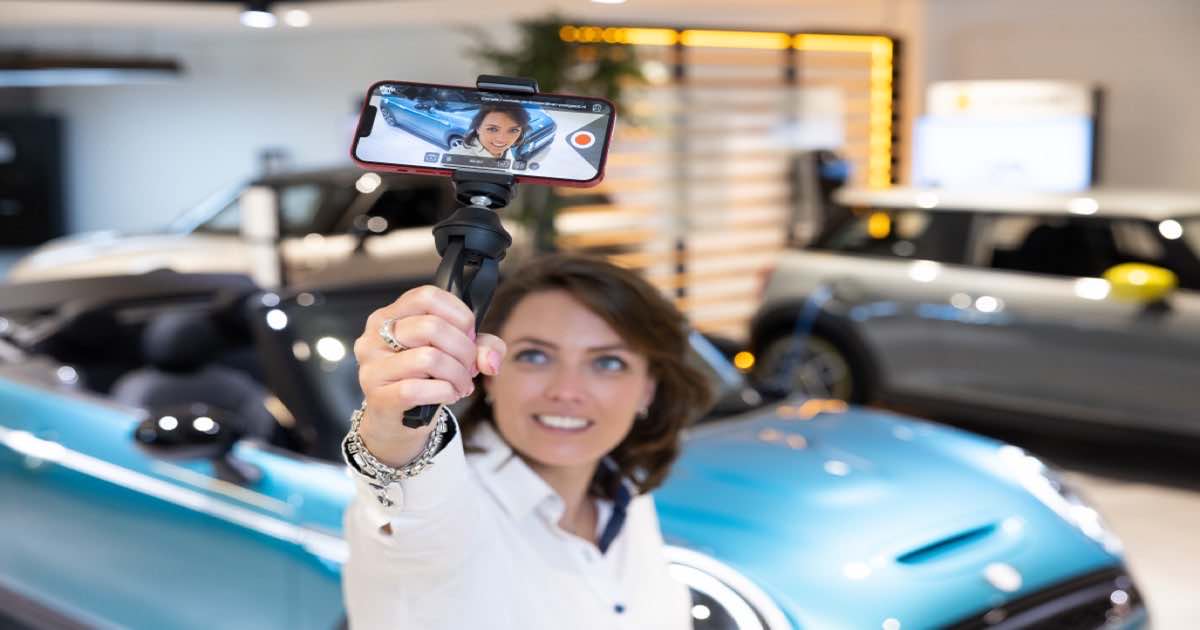
Your rep opens the app on their phone. They record 30 to 60 seconds: "Hey [name], it's [rep], I got your form on the [vehicle]. I've got it here, let me show you the exterior real quick." They pan around the car. They say where you're located, and invite them to book a time. Done.
What happens next is where the platform matters. VentaVid takes that recorded video and turns it into a branded interactive page, not just a video link. The customer opens a page that has the video, the rep's name and photo, and a button to book an appointment. Or call back directly. Or approve something, if you're in service.
The rep gets a real-time notification the moment the customer watches the video. That's the trigger to follow up: not 48 hours later, but the minute they're engaged.
Delivery goes wherever the customer actually is: SMS, WhatsApp, or email. Most customers watch within 15 minutes of receiving a personalized video link by text. That's different from email, which might sit in an inbox for a day or never get opened.
The full sharing setup at VentaVid works across all three channels from a single recorded video. The rep doesn't re-record for SMS vs email. One video, one link, sent wherever the customer is.
The 5-step workflow that gets replies
Every successful dealership video follow-up runs the same core workflow. The differences show up in execution: how fast the rep responds, how personal the video feels, and whether the platform makes it easy to act on. Here's the sequence that works:
- Step 1: Lead comes in. The form fill hits your CRM. Your BDC or floor rep is assigned within minutes.
- Step 2: Open the app within 5 minutes. The rep pulls up VentaVid on their phone. They don't need a script. They don't need lighting. They need the customer's name and the vehicle they inquired about.
- Step 3: Record 30 to 60 seconds. The formula is: greeting, name, vehicle confirmation, quick exterior pan, call to action. "Hey Sarah, it's Marcus over at [Dealership]. You asked about the 2024 CR-V in Sonic Grey. I've got it right here on the lot. Let me show you the front end." Pan the car. "We'd love to set up a time for you to come see it. Here's my direct line, or click below to grab a slot that works for you."
- Step 4: The video becomes an interactive page. VentaVid wraps it in a branded landing page. The customer sees your dealership's colors, the rep's name, and a button to book an appointment directly. No hunting for a phone number, no navigating to a different page. The action is right there.
- Step 5: Send via SMS. The rep hits send. The customer gets a text with the video link. The moment they tap to watch, the rep gets a notification. That's the window to follow up: while the customer is actively engaged.
The full workflow, start to finish, takes under 2 minutes for an experienced rep. For a new rep, give it a week. By the second week, they're faster than typing an email template.
Want to see the workflow on your own inventory before rolling it out? See how VentaVid works on a quick call. Your reps can be sending videos to leads by tomorrow.
What happens to reply rates when dealerships use video
The gap between dealerships doing video follow-up and those not doing it is larger than most people realize, and one piece of evidence makes that concrete. In April 2026, DealershipGuy profiled Community Kia, a seven-location group in the midwest that made video mandatory for every internet lead. Their General Sales Manager Bryan Gelfand mystery-shopped 7 to 10 dealerships across Indiana, Ohio, Florida, and North Carolina before implementing the policy. He submitted leads to each one. He didn't get a single video back.
After making video non-negotiable, Community Kia's individual salespeople are now closing around 30% of their internet leads, and the group has roughly doubled its internet lead conversion rate. Four of seven locations are at 100% compliance.
At Hyundai of Cool Springs in Tennessee, a similar story played out. After making video mandatory within 5 minutes of lead receipt, the store hit an 87.5% engagement rate among the customers who received a personalized video. Patrick Robertson, who led the rollout, said: "Just based on the closing percentage of leads alone, it's made a profound impact on our business."
What those numbers confirm is that the tool works when you use it. The bottleneck isn't customer receptiveness (an 87.5% engagement rate means customers are watching). The bottleneck is getting reps to do it consistently, every lead, every time.
VentaVid users report a 1.5x faster sales cycle with personalized video. Deals that would have stretched across two weeks of calls and emails close faster when the customer has already seen the vehicle and built familiarity with the rep before they come in.
VentaVid users also report an 81% response rate to video messages across the automotive sales teams using the platform. Eastern Cape Ford, one of South Africa's largest privately owned motor groups, is closing 20% of sales where videos are used.
"The sales process relies on trust. With nine out of 10 customers buying their vehicles online or over the phone, it's essential to develop a connection with the customer in an effective way. We find that when we use VentaVid, we see results. The more we use it to communicate with our customers, the more sales we believe we can close."
by Daniel Wexler, Sales Manager, Pinetown Audi
Why your reps aren't doing it yet (and how to fix that)
The most common reason dealerships don't get results from personalized video isn't the tool or the customer. It's adoption. When Hyundai of Cool Springs first introduced video follow-up, only 7 videos were recorded in 10 months. The tool was available. Nobody used it.
This is normal. Reps have established habits. A new workflow that requires pointing a camera at yourself and talking for 45 seconds feels different from dialing a number. The first few times, it's uncomfortable. Most reps will default to what they know.
Three things actually move the needle on adoption:
- Make it faster than a voicemail. If the video workflow takes longer than leaving a voicemail, reps won't do it. VentaVid's record-to-send flow runs in under 90 seconds once a rep is familiar with it. The fastest reps don't even think about it. It's part of their 5-minute first-touch response. The video software guide for dealerships covers what to look for in a tool to keep friction minimal.
- Make first-touch video non-negotiable, not optional. At both Community Kia and Hyundai of Cool Springs, the change came when leadership made it mandatory. Not recommended. Not encouraged. Required. The Sales Manager sets the floor; the reps find their rhythm within it.
- Use the coaching data. VentaVid's analytics dashboard shows who's sending videos and who's not, how long the videos are, and whether customers are watching. You can see the reps at 100% compliance and the ones at 20%, and you can coach the difference. If you're thinking about virtual sales strategies more broadly, the coaching layer is what separates video as a one-time experiment from video as a system.
One more thing worth knowing: once a rep sends a video and gets a reply (especially a customer who says "you're the one who sent me that video"), they almost never go back to voicemail-only. The first positive response is worth a month of encouragement.
The ROI math for a typical dealership
When a Sales Manager asks whether this is worth it, the answer usually comes down to lead volume and close rate.
Walk the math on your own numbers. These are example inputs: plug in your actual figures.
Your numbers will differ. But 300 internet leads at $50 to $100 each is $15,000 to $30,000 in ad spend. If your current close rate on that spend is 3-4 units a month, moving it to 6-8 units on the same budget is the difference between a mediocre month and a strong one. Dealerships operate on 1-2% net margins, and a few extra units a month on the same lead count moves the whole picture.
VentaVid users report a 1.5x faster sales cycle with personalized video. Faster cycles on the same lead count mean more units moved per rep per month, without adding headcount or spend. See how VentaVid is used across the sales workflow and the difference it makes across the funnel.
Book a 15-min demo and we'll do the math on your actual lead volume live.
Frequently asked questions
What do I say in a personalized sales video?
Keep it simple: greeting, customer name, vehicle confirmation, 10-second exterior look at the specific car, and a call to action. "Hey Sarah, it's Marcus at [Dealership]. You asked about the grey CR-V. Here it is. Would love to set up a time. Click below or call me direct." Authenticity matters more than polish. A slightly awkward genuine video outperforms a slick scripted one almost every time.
How long should a video message be for car sales?
Thirty to sixty seconds for a first-touch lead response. Under 90 seconds achieves 68% completion rates, while anything over two minutes sees a sharp drop-off. If you're doing a full walkthrough for a customer who's further along in the process, two minutes is reasonable. For a cold lead who just filled out a form, shorter wins.
Should I send video by SMS or email?
SMS first. Most customers watch a video within minutes of receiving a text with a link. Email can sit for hours or days, and video thumbnails in email get stripped by some clients. If you have the customer's phone number, lead with text. If you only have email, a video link still dramatically outperforms a plain text follow-up. VentaVid delivers across SMS, WhatsApp, or email. You send once, they get it on their channel.
How do I get my sales team to use video consistently?
Make it mandatory for first touch, not optional. Tie it to your existing accountability structure. The Hyundai of Cool Springs team tied a 90% organic-video compliance rate to monthly bonuses. Combine that with a coaching dashboard that shows exactly who's at what compliance rate, and you have the data to have real conversations. The automotive marketing guide covers team-level video adoption as part of a broader engagement strategy.
Does personalized video work for BDC follow-up?
Yes, and it may work better in the BDC context than on the floor, because BDC reps are already doing dedicated follow-up work and aren't splitting attention with floor traffic. A BDC rep who sends a personalized video instead of a fifth voicemail can stand out in a way that's genuinely unusual. Bryan Gelfand at Community Kia mystery-shopped 10 dealers and got zero videos back. If your BDC is doing video and competing stores aren't, the customer notices.
What's the difference between a personalized video and a regular video email?
A plain video email is a link to a video. A personalized video page (what VentaVid builds) is a branded interactive page where the customer can watch the video and take an action from the same screen: book an appointment, call you directly, or reply. There's no hunting for a phone number or navigating elsewhere. That's the difference between a video the customer watches and forgets, and one they act on.
Talk to us
If you run sales at a dealership and you're losing deals to voicemails and emails that nobody opens, a 15-minute demo is the fastest way to see what video changes. We'll show it on your own inventory, with your rep's workflow in mind.
What it takes to start.
- 7-day free trial, no credit card required.
- No editing skills needed. Your reps shoot on the phones they already carry.
- We'll show it on your own inventory on the call.
A real person from the VentaVid team runs these demos on your inventory.