
Deposit dispute, defined: a disagreement over deposit deductions at the end of a tenancy, decided on the evidence each side submits
A deposit dispute is a formal disagreement between a landlord or letting agent and a tenant about what, if anything, should be deducted from a protected tenancy deposit when the tenancy ends. In England and Wales it is usually resolved through the free alternative dispute resolution (ADR) service run by the scheme holding the deposit, with the county court as the fallback.
The definition matters because the adjudicator never visits the property. The decision rests entirely on what each side uploads, so the dispute is won or lost on the quality of the record made at check-in and check-out, months or years before anyone disagreed.
How a deposit dispute works
The sequence is the same across the three government-approved schemes in England and Wales (TDS, DPS and mydeposits). Scotland and Northern Ireland run their own schemes with a similar process.
- Proposed deductions. At the end of the tenancy the landlord or agent states the amount they want to keep and why: cleaning, damage, unpaid rent, missing items.
- Negotiation. The tenant agrees, rejects or counter-offers. Any agreed portion is released straight away.
- Raising the dispute. Either party asks the scheme to adjudicate the disputed amount. The tenant normally has three months from the end of the tenancy to do this. Both sides must consent to ADR; if the landlord refuses, the tenant's route is the court.
- Evidence window. Each side gets a fixed number of days to upload its evidence. Late evidence is usually not considered.
- Decision. An adjudicator reviews the file and decides on the balance of probabilities. The decision is binding once accepted and the scheme pays out accordingly.
One principle shapes everything: the deposit is the tenant's money. The landlord is the party claiming it, so the landlord carries the burden of proving the tenant caused the loss. Where the evidence is thin, the money goes back to the tenant.
What evidence adjudicators accept
Adjudicators want to see a chain that starts before the tenant moved in and ends after they left. In practice the file that wins contains:
- A signed check-in report or inventory describing each room, with dated photographs embedded in it, not sent loose.
- A check-out report compiled as soon as the keys are returned, ideally by the same person or firm, using the same room order and the same photo angles.
- The tenancy agreement, so the adjudicator can see who was responsible for what.
- Invoices, quotes or receipts for the work claimed, plus an allowance for fair wear and tear and the age of the item.
- Correspondence during the tenancy: repair requests, warnings about condition, any mid-term inspection notes.
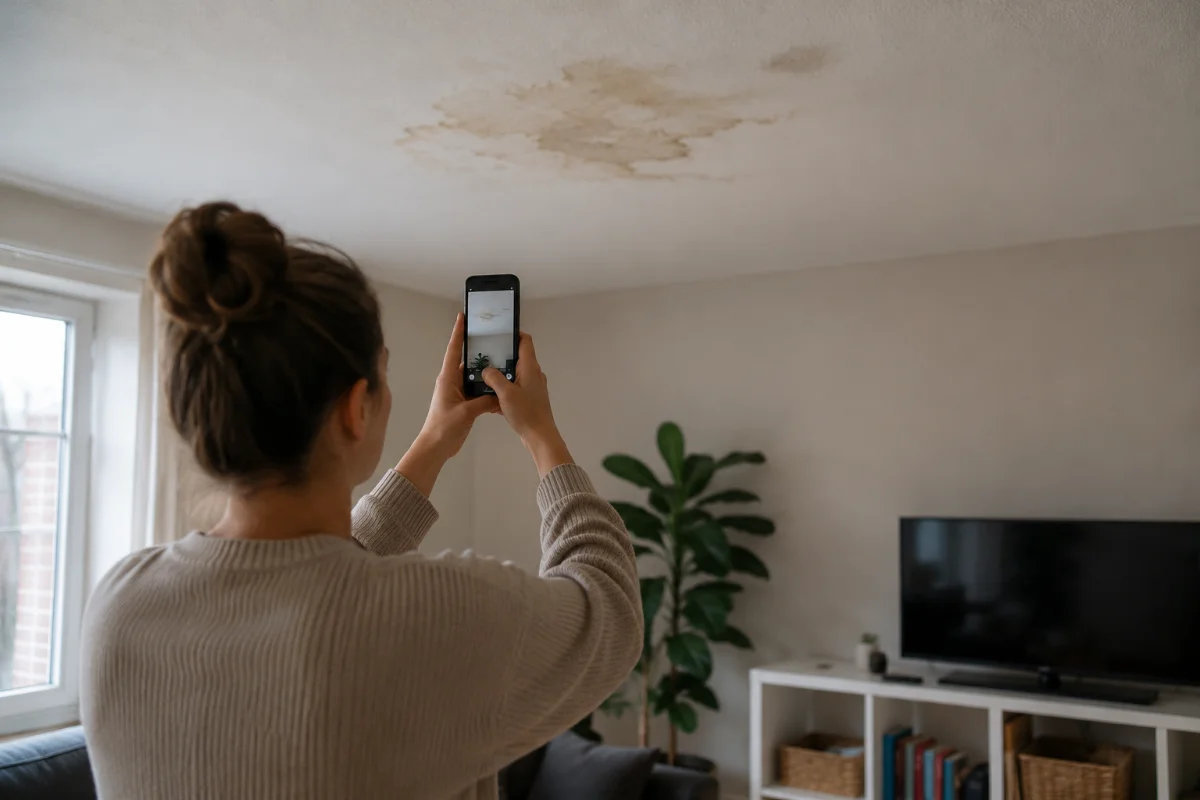
Photos carry weight only when they can be tied to a date and a place. A picture of a stained carpet with no timestamp, no room reference and no matching check-in shot proves that a carpet was stained at some point, and nothing more. Video walk-throughs are accepted and often persuasive, provided the narration names the room and the file carries its own timestamp.
Deposit dispute example: the marked bedroom wall
A two-bedroom flat is returned with scuffed paintwork and a set of picture-hook holes in the main bedroom. The agent claims the cost of repainting the whole room. The tenant says the marks were there at check-in.
The check-in report describes the bedroom walls as "good condition, freshly painted, no marks" and includes four photographs, one per wall, taken the day the keys were handed over. The check-out report shows the same four walls with the holes and scuffs and is dated the day the tenant left. The adjudicator accepts that damage occurred during the tenancy, but the paint was already two years old, so the award is a proportion of the redecoration cost rather than the full amount.
Change one fact and the outcome flips. With a check-in report that said "walls: fair" and no photographs, the adjudicator could not tell whether the holes predated the tenancy, and the claim would most likely fail.
What a deposit dispute does not do, and the mistakes that lose them
It does not decide who was a good tenant. Adjudication is about the disputed sum and the evidence for it, not conduct or character.
It does not award betterment. A landlord cannot use a deposit to replace a worn ten-year-old carpet with a new one at the tenant's expense.
It does not replace the court. Claims above the deposit amount, or cases where one side refuses ADR, go to the small claims track instead.
The mistakes that come up again and again: an inventory with no photographs, photographs with no inventory, check-out carried out weeks after the tenant left (so the landlord cannot show the property was not entered in between), before-and-after shots taken from different angles or in different light, and evidence that lives on someone's phone with no date or file history attached.
Where the deposit dispute record goes
The scheme's online portal holds the evidence packs and the decision. Agents keep the check-in and check-out reports on the property file well beyond the end of the tenancy, because the three-month window means a dispute can arrive long after the keys are back. The comparable process for a hire vehicle or equipment deposit, where the operator holds a card pre-authorisation rather than a scheme-protected sum, is covered under security deposit. A practical walk-through of the tenant-side evidence is in tenant self-inspection.
Venta Capture, a product of VentaVid, is one way to build that record without the agent attending every check-in: the tenant or the inventory clerk is sent a secure, personal capture link, follows the guided room-by-room steps in the mobile browser with no app, and the photos and video arrive timestamped and digitally sealed, ready to sit inside the evidence pack if a dispute ever comes. Details at the Venta Capture pages.
In practice: see how insurers use Venta Capture for remote claim inspection.