
What is a home insurance claim: the household claim explained
A home insurance claim is a request for repair, replacement, or payment made under a household policy after damage, loss, or theft at an insured address. It covers two distinct sections of cover, buildings and contents, and which section responds decides the evidence needed, the supplier appointed, and how long the claim runs.
For insurers
See the damage before you send anyone
Venta Capture, a product of VentaVid, sends the policyholder a link. They film the damage on their own phone, guided step by step, and the evidence lands with the claim.
Household claims run longer and cost more than motor. UK insurers paid almost 3.4 billion pounds across more than 560,000 home insurance claims in 2025 according to the Association of British Insurers, with the average claim rising 15 per cent year on year to around 6,000 pounds.
Buildings or contents: where the boundary sits
This is the single most common source of confusion on household claims, and the fastest way to settle it is the upside-down test. Turn the house upside down: what falls out is contents, what stays put is buildings.
- Buildings. The structure itself, plus permanent fixtures: walls, roof, floors, fitted kitchens, bathroom suites, built-in wardrobes, boilers, and usually outbuildings, drives, walls, and fences.
- Contents. Movable possessions: furniture, clothing, electronics, carpets that are not fitted, curtains, jewellery, tools, and the contents of outbuildings.
- The grey zone. Fitted carpets, integrated appliances, and garden structures vary between wordings and are worth checking against the policy schedule rather than assuming.
Most real household losses hit both sections. A burst pipe destroys the ceiling below, which is buildings, and the sofa underneath it, which is contents. Where the loss is possessions only, the handling is different enough to be treated separately in contents claim.
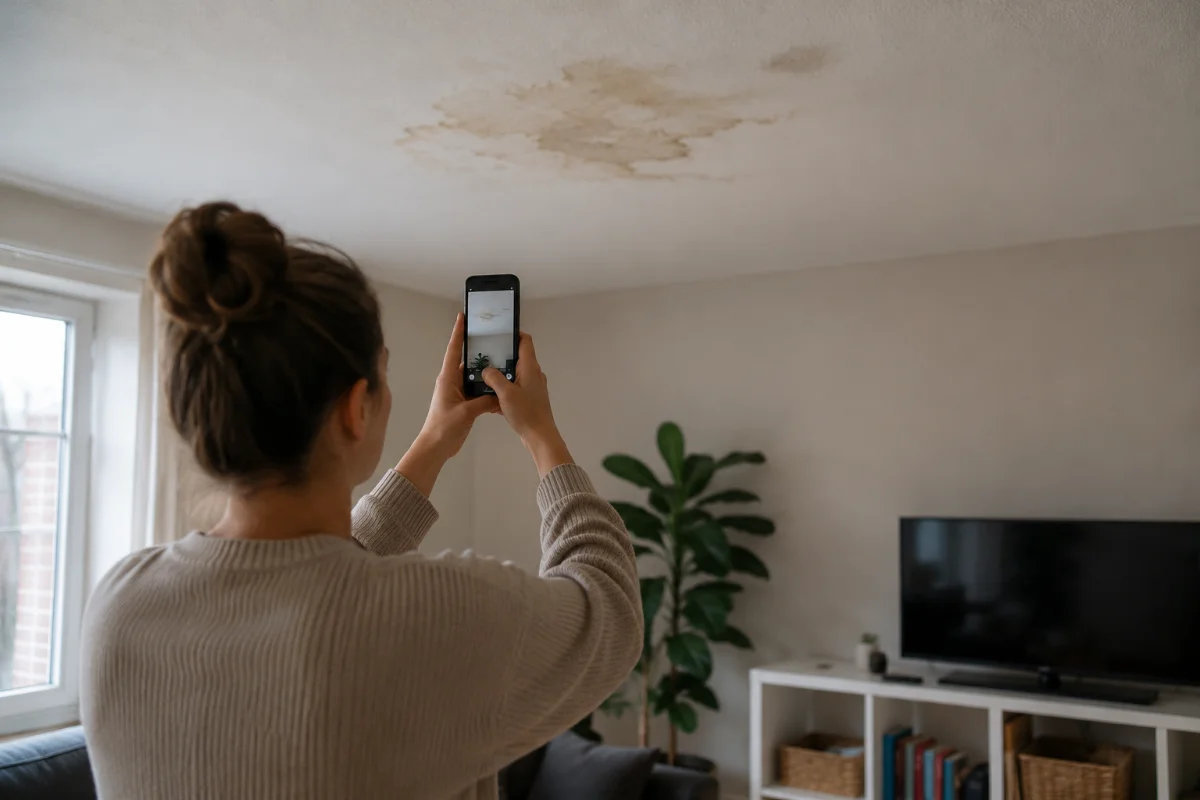
How does a home insurance claim work, step by step?
- Notification. The customer reports the loss, ideally with the peril, the date, and the extent of damage already stated. See first notification of loss.
- Emergency mitigation. Stop the leak, board the window, make the property safe. Insurers expect reasonable steps to limit further damage.
- Cover and cause check. The peril has to be insured and the cause established. Gradual damage and wear are excluded almost everywhere, and this is where most declines originate. See claims validation.
- Assessment. Desk assessment from photographs and video for lower value claims, a loss adjuster visit or surveyor report for larger or complex ones.
- Scope and schedule. The repair scope is agreed, contents are scheduled item by item, and alternative accommodation is arranged if the home is uninhabitable.
- Authorisation and works. Contractors are appointed, drying and strip-out begin where relevant, then reinstatement.
- Settlement and closure. Cash settlement, replacement, or completed repair, followed by final invoicing and closure.
What evidence is normally required
- Photographs and video of the damage. Wide shots establishing the room, then close shots of each damaged area, plus the source of the damage where it is visible.
- Cause evidence. The failed joint, the split hose, the lifted roof tile, the forced door. Cause decides cover, so it is worth capturing before anything is cleared up.
- Proof of ownership and value. Receipts, bank or card records, guarantees, valuations for high value items, and photographs of the item in the home.
- Official references. A police crime reference for theft or malicious damage.
- Third party reports. Plumber, electrician, roofer, or drainage report, particularly where the insurer needs to know whether the failure was sudden or gradual.
- Property context. Age of the property, previous claims at the address, and any prior repair to the same area.
Home insurance claim example: an escape of water
A flexible hose under a first floor basin fails on a Saturday. Water runs for several hours, bringing down part of the kitchen ceiling below and soaking a rug and a bookcase.
The buildings side covers the ceiling, the plaster, the electrics, and the drying. The contents side covers the rug and the bookcase. One event, one claim reference, two sections of the policy, two suppliers, and two different sets of evidence. The customer who photographs the failed hose before the plumber removes it saves themselves a fortnight of argument about whether the failure was sudden.
What typically slows a home insurance claim down
- Cause disputes. Sudden and accidental is covered, gradual deterioration is not, and the distinction is often argued from photographs taken after the evidence was thrown away.
- Adjuster and surveyor scheduling. Appointment availability adds days before anyone has looked, and surges after a storm make it worse.
- Drying time. Water damage cannot be reinstated until the structure is dry, which is a fixed physical delay of weeks on some properties.
- Contents schedules. Listing damaged possessions item by item, with values and proof, is slow work and customers do it in fragments.
- Contractor availability. Trades, scaffolding, and specialist materials for older or listed properties.
- Retake loops. Photographs that miss the cause, the extent, or the room context send the file back to the customer, and each round costs days rather than minutes. Insurance claim documentation covers what a complete first submission looks like.
Where the big money goes
Weather now shapes the household portfolio. The ABI reported 6.1 billion pounds in total UK property payouts in 2025, the highest annual figure on record, including 312 million pounds of domestic flood claims with average flood payouts rising 60 per cent to around 30,000 pounds, 244 million pounds of storm damage at an average of 2,450 pounds, and 307 million pounds of subsidence.
The operational consequence is surge. A single named storm produces thousands of notifications in 48 hours, all needing assessment, and the claims that get assessed quickest are the ones that arrived complete.
In practice: see how insurers use Venta Capture for remote claim inspection.