

The short version.
- Equipment verification has to answer five things: the asset exists, it matches the paperwork, it is in the stated condition, it sits where the agreement says, and it runs.
- Field examination fees in real credit agreements run $500 to $1,250 per day per examiner, which is why the annual check quietly stops happening.
- Guided capture uses the person already standing next to the machine, so the file arrives with identifiers, condition, environment, and operation in one structured case.
- Written for risk managers in asset finance and equipment leasing, and for fleet or operations managers who own the machines.
Somewhere in your portfolio there is a machine nobody on your team has ever seen. It was funded off an invoice, a photo, and a supplier's word. Eighteen months later you know its balance to the cent and almost nothing about its condition.
That is the gap equipment verification is supposed to close. In practice it closes for the assets big enough to justify a plane ticket, and stays open for everything else.
If you carry the risk on financed or leased equipment, or you run a fleet where the machine is always three hours away, the problem is rarely that you don't know what to check. It's that checking requires a person, a diary, and a day rate. Venta Capture, a product of VentaVid, takes a different route: send a link, let whoever is already standing next to the machine record what you need, and get it back as a sealed case. Start a free account and build one verification flow against a single asset class before you decide anything bigger.
In this post:
What equipment verification has to answer
Strip away the process and every verification request is the same handful of questions, asked before money moves or before someone gets dispatched.
Does the asset exist? Is it the machine on the invoice? What condition is it actually in? Where is it sitting? And does it run?
The fraud literature is blunt about why those questions matter. In a widely cited breakdown of equipment finance fraud, attorney Andrew K. Alper lists ten distinct fraud categories in Monitor Daily, and two of them are pure existence problems: fictitious equipment, where the lessee and a cooperating supplier split the funding on a machine that was never delivered, and double or triple financing, where one real machine is pledged to several lenders at once. The Equipment Acquisition Resources case ran on exactly that pattern, sham sales across multiple lenders, ending in a federal indictment.
Fictitious and double-financed equipment are not condition problems. They are existence problems, and only something that puts eyes on the machine solves them. A credit memo cannot. A signed delivery receipt cannot, because in the fictitious-equipment schemes the receipt is signed by someone in on it.
The industry knows the shape of it. The Equipment Leasing and Finance Association's own fraud session drew more than 175 industry professionals and split the problem into borrower fraud, vendor fraud, and transaction fraud, with sham vendors who disappear after payment sitting right in the middle.
So a verification capture needs five shows, in this order:
- Show the equipment. The whole machine, walked around, not a cropped hero shot.
- Show the identifiers. Data plate, serial number, hour meter or odometer, close enough to read.
- Show the condition. Wear points, damage, tyres or tracks, fluid leaks, the things a valuer would photograph.
- Show the environment. What surrounds it, which tells you whether it is where the agreement says.
- Show it operating. Start it, move it, run the function it was bought for.
Miss the fourth and fifth and you have a photo album. Get all five and you have something a credit committee can look at.
Why the periodic check never happens
Here is the part I actually went and checked. I spent an afternoon reading publicly posted equipment lease and credit agreement clauses, because I wanted to know whether the right to inspect is missing or just unused.
It is not missing. A standard lessor's inspection clause gives the right to enter the premises and inspect the equipment during business hours, and plenty of agreements cap what the lessee has to reimburse at one inspection per year. The right is there. The cost of exercising it is the problem.
Sample credit agreements price field examinations at $500, $1,100, or $1,250 per day per examiner, plus out-of-pocket expenses. That is before travel time, before scheduling around the site's operating hours, and before the examiner discovers the machine moved to a different job last week.
Run that against a modest book. Say 300 financed assets and a policy of physically checking a 10% sample once a year. Thirty inspections, one examiner-day each at the middle of that range, is roughly $33,000 and about six working weeks of somebody's calendar. Double the sample and you have a headcount conversation.
So the sample shrinks. Then it shrinks again. The clause stays in the agreement and the check stops happening, which is a quiet way of saying the portfolio is verified once, at funding, and never again.
The paperwork load doesn't help. A single leasing or equipment financing application already pulls together 8 to 15 separate documents before anyone gets near the asset itself. Adding "and go look at it" to that stack is what gets cut when the queue backs up.
If that is roughly your situation, the cheapest experiment is one flow against one asset class. Open a free account and build the five shows into a capture request, then send it to ten existing accounts and see what comes back.

Guided capture, in practice
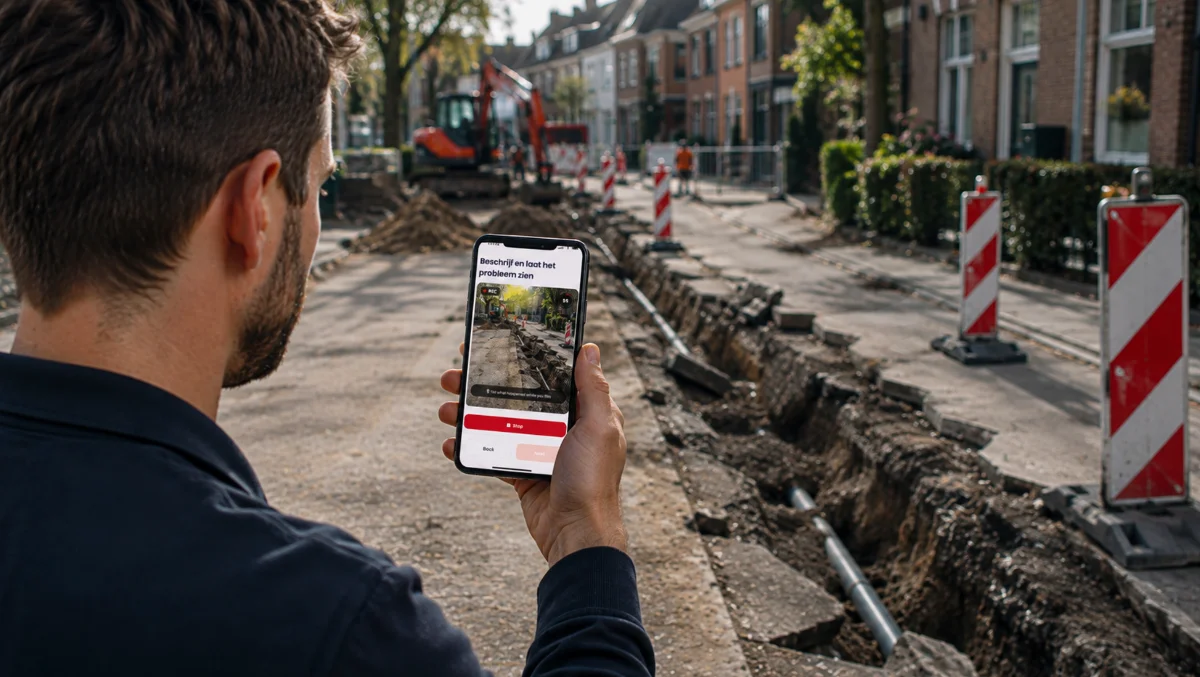
The mechanism is simple enough to explain in a sentence: you send a link, the person on site opens it in their phone browser, and the flow tells them what to record, step by step.
No app to install. No account to create. It runs in the mobile browser on whatever phone the operator, driver, or site manager already has, in any of 15 languages.
The important part is who decides what gets captured: your team, not the person holding the phone. An operator who has never valued a machine doesn't know that you need the data plate legible, the hour meter in frame, and thirty seconds of the boom actually moving. The flow knows, so it asks in order.
A verification flow for a financed machine usually looks like this:
- Whole machine, walkaround. Slow pass around all four sides, recorded live rather than pulled from the camera roll.
- Data plate and serial. A held shot close enough to read, with the serial spoken aloud as well.
- Hour meter or odometer. Ignition on, display in frame.
- Condition close-ups. Whatever your risk policy cares about: undercarriage, attachments, cab, hydraulics, glass.
- Environment. A pan of the yard, site, or workshop the machine is standing in.
- Operation. Start it and run the primary function while narrating what it's doing.
- Spoken explanation. Anything unusual, described out loud and transcribed into the case.
What comes back isn't an email thread with nine attachments. It's a structured case in a shared inbox: video, photos, answers to your conditional questions, the transcript, and the technical context around the submission. Reviewers can assign it, comment on it, or request a retake of one specific step without re-running the whole thing.
That distinction matters more than it sounds. "Send us some photos" produces whatever the sender thought was relevant. Guided capture produces the same eight views on every asset, which is what makes a portfolio comparable instead of anecdotal. You can see the same pattern in how teams use it for a rental condition report, where the before and after have to line up view for view.
The video inspection platform side of the product is where those flows get built, with a drag-and-drop builder and conditional questions, so a "does the machine have an attachment fitted?" answer can branch into three more capture steps.
What the file has to prove months later
Verification files have an awkward property. They are least interesting on the day they arrive and most interesting the day somebody disputes the decision they supported.
The pattern repeats: day one the capture arrives, day two an analyst reviews it, week two the deal funds, month eight a dispute opens, and a year later someone asks which exact file the original decision was based on. If the answer is "a JPEG on a shared drive, probably", the file has stopped being evidence.
So the integrity layer is not decoration on a financing file. As stated on the remote claim inspection page, each submission gets:
- A SHA-256 digital fingerprint of every file on arrival, so you can check later whether the file you're reviewing is byte-for-byte the one that was received.
- A server-side time of receipt, set by the system rather than by the participant's phone clock.
- GPS location verification to within ±11m, recorded with the capture.
- 28 control points per submission: 10 automatic signals, 21 recorded session events, and one signed seal that can be verified with a public key outside the platform.
- An audit trail of what happened after the case landed: reviewed, assigned, status changed, retake requested, progressed.
Now the honest part, because this is where remote verification pitches usually overreach.
The receipt timestamp proves when the system received the submission. It does not prove when the damage happened, when the machine was delivered, or when the hour meter read what it read. Those are different claims and the file should not be described as if it settles them.
Nor does any of this make fraud impossible. A genuine live recording can still show a staged scene, a borrowed machine, or a serial plate from a different unit. Control-point signals are a reason to look harder, never a verdict, and the decision stays with the person reading the case. Treat them the way a credit team treats a covenant breach alert: it opens a conversation, it doesn't close one.
What the layer does buy you is a file that survives being questioned. Same argument holds when the dispute is about a repair rather than an asset, which is why the logic carries across to a warranty claim inspection or an insurance claim documentation file.
Ready to see what your customers see?
Send one link. Get guided, verified video back. No app, no account.
When to ask for a verification capture
Verification is usually treated as a pre-funding event. It's more useful as six triggers spread across the life of the asset, each with its own capture request.
The pre-funding row carries most of the weight. Alper's advice in Monitor Daily is specific about this: insist on itemised invoices listing serial numbers, and treat equipment shipped somewhere other than the lessee's place of business as a red flag worth chasing. A capture that shows the plate and the surroundings answers both in one submission.
Delivery and dispatch triggers are where the operational saving shows up rather than the risk saving. Seeing the fault and the machine before sending anyone is the same "know before you go" move that field service teams make when they triage remotely, and it's the difference between one visit with the right part and two visits with the wrong one.
Recurring verification: remote visibility over time
The interesting move is not verifying once. It's verifying on a cadence: January, April, July, October, the same flow, the same views, the same asset.
Four short captures a year on a leased excavator gives you a condition trend instead of a funding-day snapshot. You see the undercarriage wearing, the hours climbing faster than the contract assumed, or the machine quietly relocating to a site three counties away.
One caveat, stated plainly, because the market oversells this. Venta Capture does not schedule recurring captures for you. Your team sends each periodic request, from your own calendar, your servicing system, or a webhook off your portfolio management platform. The application works because sending a request costs nothing, not because a scheduler runs it in the background.
The economics are why the cadence becomes realistic at all. Thirty examiner-days at $500 to $1,250 buys you a 10% sample once a year. The same budget spent on capture requests covers the whole book four times over, and you still hold back some inspection budget for the assets that come back looking wrong.
That is the honest promise: remote-first, not remote-only. In field service, where the same "look before you travel" logic applies, Venta Capture reports a 79% reduction in field service visits required. Read that as a field-service number, not a lending one. What it tells you about a portfolio is directional: most checks don't need a person on site, and the remaining ones get better targeted.
Machine-side, this is the same loop that remote claim inspection teams already run on a damage file, only pointed at condition instead of cause.
Frequently asked questions
What is equipment verification in asset finance?
It's the process of confirming that a financed or leased machine exists, matches the paperwork, and is in the stated condition and location. It typically happens before funding and at lease start, and covers the serial number, hour meter, physical condition, and operating state.
Can equipment verification be done remotely?
Yes, when the capture is guided rather than open-ended. The person on site records specific views in a set order through a link, which gets you the identifiers, condition, environment, and operation without an inspector travelling. Physical inspection stays on the table for the assets that come back looking wrong.
How do you verify a serial number remotely?
You ask for the data plate itself, held steady and close enough to read, and ask the participant to say the serial aloud so it lands in the transcript too. Then you match it against the serial on the itemised invoice. A mismatch between plate and invoice is exactly the double-financing signal Monitor Daily's fraud breakdown flags.
Does the timestamp prove when the equipment was in that condition?
No. The server-side timestamp proves when the system received the submission, not when the event or the damage occurred. It is useful because it is set by the system rather than the participant's phone, but it should never be described as proof of the timing of the underlying event.
Can guided capture stop double financing?
It makes the scheme harder to run, not impossible. Requiring live capture of the data plate, hour meter, and surroundings raises the effort needed to pass off a machine that is already pledged elsewhere, and the recorded signals give a reviewer reasons to look closer. The decision to fund still belongs to your credit team.
Does Venta Capture schedule recurring verifications automatically?
No. Your organisation sends each periodic capture request, whether that's manually, from a calendar, or through the API and webhooks. The recurring-verification pattern works because requests are cheap to send, not because the platform runs a scheduler on your behalf.
See it on one asset class
Don't roll this out across the book. Pick the asset class that annoys you most, the one where the condition disputes cluster, and build one flow with the five shows in it.
Send it to ten live accounts. Look at what comes back, then decide whether the field-exam budget is still buying you the right things.
What it takes to start.
- Free account to start, no credit card required.
- No app for the person on site, it opens in their phone browser.
- Build one flow, send ten requests, see the cases land before you commit to anything.
The VentaVid team builds guided capture for teams that have to make decisions about things they can't stand next to.
Start a free account, or book a demo and we'll build a verification flow against one of your own asset classes on the call.