


This post in 30 seconds.
- What it is: remote claim inspection means assessing a reported loss from visual evidence captured at the scene, without dispatching an inspector to every claim.
- The frame that matters: there are three categories of inspection. Physical solves "someone needs to see it." Live video solves "our expert doesn't need to travel." Asynchronous guided capture also solves "our expert doesn't need to be there at the same time."
- The honest catch: remote inspection is remote-first, not remote-only. Complex losses, disputed liability, and red-flagged files still deserve a person on site.
- Who this is for: claims directors and heads of claims operations at motor, home, and property insurers who are watching cycle times and field costs climb together.
Every claims director runs the same quiet calculation. Which of this week's new claims need a person standing at the loss, and how many are waiting for a visit purely because nobody could see the damage any other way? The gap between those two numbers is where cycle time, loss adjustment expense, and claimant patience quietly drain away.
Remote claim inspection closes that gap. The claimant captures the loss on their own phone, and your team assesses it from the desk. That shifts a claim's first real look from "whenever the field calendar allows" to the same day the loss is reported. With the average property claim now taking more than 44 days from first notice of loss to final payment, according to J.D. Power's 2025 U.S. Property Claims Satisfaction Study, the longest since the study began in 2008, those early days are the cheapest ones to win back.
If you run claims operations at a motor, home, or property insurer, you already know the math of the field calendar: the inspection backlog grows faster than the team that drives to it. We built Venta Capture, a product of VentaVid, so claimants can record a loss on their own phone and your handlers can review it as a sealed evidence case the same day. Create a free account and send yourself a test capture link before your next claims meeting.
In this post:
What remote claim inspection actually means
Remote claim inspection is the practice of assessing a reported loss using visual evidence captured at the scene, so a qualified handler can understand the situation without traveling to it. The person already standing next to the damage, usually the claimant, provides the eyes and the camera. The insurer provides the expertise.
That last part is what separates real remote inspection from what most insurers do today, which is some version of "please send us some photos of the damage."
Unguided photos fail in predictable ways:
- No context. The dented panel arrives without the vehicle around it, so nobody can place the damage.
- No detail. The wide shot of the room hides the hairline crack the whole claim turns on.
- No story. The damp ceiling comes in alone, with no floor, no adjacent wall, no suspected source.
I have yet to meet a claimant who knows what a damage assessor needs to see, and there's no reason they should. So the handler writes back, requests two more photos, waits, and the file ages another week.
A proper remote inspection flips who decides what gets captured: the insurer defines the required views, and the claimant is guided through collecting them. A guided video inspection platform turns your best assessor's checklist into a step-by-step capture flow, so the right evidence arrives the first time.
The stakes on evidence quality are not small. The Coalition Against Insurance Fraud puts the annual cost of insurance fraud in the United States at $308.6 billion, and weak, unverifiable evidence is exactly the environment that number grows in.
The three categories of claim inspection
Most articles about this topic treat "remote" as one thing. It isn't. There are three distinct categories, and the difference between the second and third is where the operational gains actually live.
Live video inspection was a genuine step forward. It removed the drive. But it kept the appointment: a claimant available at 14:00 plus an adjuster available at 14:00, multiplied across every claim in the queue. Remote isn't the whole story. Asynchronous is.
Consider what happens after a storm weekend. Five hundred policyholders need to show damage. With live sessions, someone has to staff a meaningful share of those calls, and your capacity is capped by adjuster availability. With asynchronous guided capture, all 500 claimants receive a link, capture independently, and the resulting cases queue for desk review by priority. Capture capacity stops being coupled to employee availability, which is a different operating model, not a faster version of the old one.
Why claims teams are moving inspection remote
The pressure comes from three directions at once: cycle time, field cost, and the collapsing trustworthiness of unguided photo evidence. None of the three is easing on its own.
Cycle time is a satisfaction problem
J.D. Power's 2025 property claims data puts the average repair cycle at 32.4 days. The same study shows what that does to claimants: satisfaction scores average 762 out of 1,000 when repairs finish within 10 days, and fall to 595 when they stretch past 31 days. A claim that gets its first visual assessment on day one, instead of waiting for a field slot, starts that clock earlier and often skips the queue entirely.
Field inspection is expensive in the wrong places
A field visit costs drive time, inspection time, and write-up time, and on low-severity claims most of that cost buys you information a guided capture could have delivered the same morning. Nobody is proposing to eliminate the field team; the waste is spending their hours confirming things a desk review could have settled.
Photo evidence is under attack
This is the quiet one. Allianz UK reported a roughly 300% increase in claims involving app-manipulated images between 2021-22 and 2022-23, the so-called shallowfake problem, and Zurich UK has issued the same warning. And in Belgium, insurance federation Assuralia reported €181 million in proven insurance fraud in 2025, 25% more than the year before, while estimating the real damage at up to €800 million annually. When a claims process runs on gallery uploads and email attachments, every one of those trends lands directly on your handlers' desks.
An emailed JPEG tells you almost nothing about itself. Was it taken today or found online? Edited before upload? Is the file you're reviewing in month eight still identical to the one you received on day one? Unguided photo intake can't answer any of that. A sealed capture process can answer some of it, and we'll be precise below about which parts.
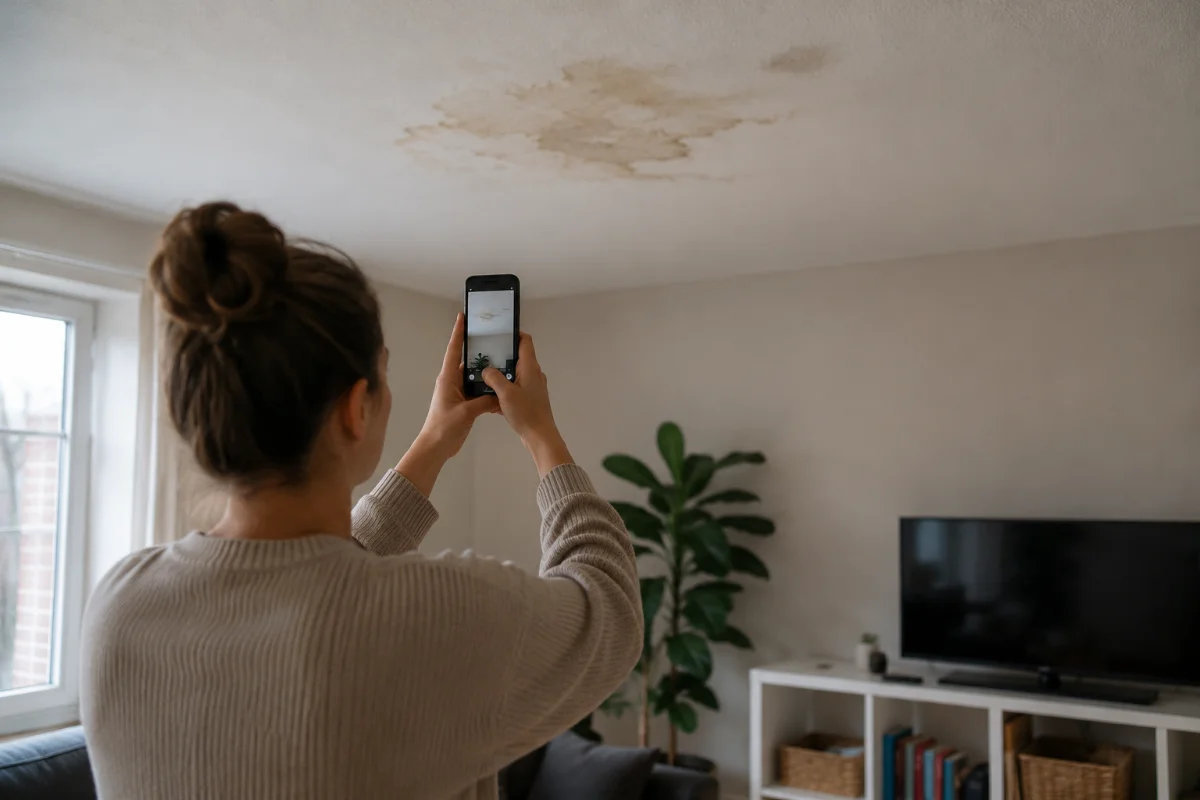
How an asynchronous remote claim inspection works, step by step
Here's the workflow with Venta Capture as the worked example. Other tools sequence it differently, but the shape is the same: guide the capture, structure the case, review on your schedule.
- The claim triggers a capture request. At first notification of loss, the handler (or your FNOL automation) sends a personal capture link by SMS, email, or WhatsApp. No app to install, no account to create, which matters because every installation step loses claimants.
- The claimant opens the link in their phone's browser. The flow greets them in their own language (Venta Capture supports 15) and walks them through exactly what to show: the whole vehicle, then the damaged side, then the damage up close, then the odometer. Or for a water leak: the room, the ceiling, the wall, the suspected source.
- They record live, step by step. Video and photos are captured in real time inside the flow, not selected from the gallery, and the claimant can explain what happened while recording. Spoken explanations are transcribed and become searchable in the case.
- Conditional questions fill the gaps. Was anyone injured? Is the vehicle drivable? Is the water still running? Answers route the flow and arrive attached to the evidence instead of buried in a phone note.
- The submission arrives as one structured case. Video, photos, answers, transcript, timestamps, and integrity data land together in a shared inbox where your team assigns, comments, and progresses the file, instead of arriving as seventeen attachments across three email threads.
- The handler reviews and decides. Settle remotely, request a targeted retake ("please record the left side again and include the rear wheel"), escalate to a field inspection, or route to your fraud team. The retake loop is the unsung hero here: a missing angle becomes a two-minute request instead of a restarted claim.
The same guided flows work for motor damage, property damage, and contents claims, and the pattern extends past insurance: dealerships run structurally identical flows for trade-in appraisals and damage documentation.
Want to see a capture flow built around one of your own claim types? Book a 15-minute demo and bring a real claim file to rebuild live.
What a digitally sealed evidence case adds
Collecting the footage is half the job. The other half is being able to stand behind it, in month one for the decision and in month eighteen if the file is disputed.
A sealed evidence case wraps the captured material in verifiable context about how it was collected, received, and handled. In Venta Capture, each submission carries 28 control points: 10 automatic signals, 21 recorded session events, and one signed seal. The layers, in plain terms:
- Server-side time of receipt. The system records when the submission arrived, independent of the phone's clock setting.
- SHA-256 fingerprints. Every file gets a cryptographic fingerprint. If the file changes, the fingerprint changes, so you can prove months later that today's file is the one originally received.
- A signed seal. The submission is sealed and can be verified outside the platform with a public key, so integrity doesn't rest on someone reading a value off a vendor dashboard.
- A session timeline. Recorded events from the capture session sit alongside the footage, so a reviewer sees the process around the evidence, not just the end product.
- Capture-only intake. Recording happens inside the flow. Gallery uploads, and the record-edit-export path that comes with them, are off the table.
- Technical signals. Device context, virtual-camera detection, jailbreak detection, and location checks surface as graded signals (ignore, info, amber, red) that your team weighs against its own risk policy.
Now the honest part, because this is where a lot of vendor copy oversells and where your fraud team will rightly push back.
What a sealed case does not prove.
- The server timestamp proves when the system received the submission. It does not prove when the damage occurred. Those are different facts, and conflating them is how evidence gets discredited.
- Harder to manipulate does not mean impossible to deceive. A genuine live recording can still show a staged scene or a conveniently framed one.
- Signals are reasons to look closer, never verdicts. A device that appears on multiple claims may have an innocent explanation. The decision stays with your handlers and your SIU, not with a score.
Framed that way, sealed evidence does something subtle but valuable: it lets your team trust routine claims faster, and concentrate investigative attention where signals actually accumulate. Aviva detected £233 million in suspected fraudulent claims in 2025, and motor insurance alone represents over 70% of the fraud it detects. Volume like that cannot be investigated evenly; it has to be triaged on evidence quality.
The Venta Capture remote claim inspection page walks through the full sealed-evidence model control point by control point, if you want the product-level detail this guide deliberately stays above.
If the evidence layer is the part your team has been missing, start a free account and inspect a sealed test case yourself. No credit card required.


Where remote inspection stops
Any vendor who promises you'll never dispatch an adjuster again is selling something other than claims handling. The model that works is remote-first, not remote-only: see first, act second, and let what you see decide what happens next.
A guided capture typically resolves into one of four outcomes:
- Settle remotely. The evidence is sufficient, the severity is in range, the file progresses same-day.
- Request more. A targeted retake or a follow-up question fills the gap without restarting the process.
- Escalate to the field. Structural damage, disputed liability, injuries, or severity beyond a desk decision. The visit happens, and it happens better informed: the adjuster arrives knowing what they're walking into, what expertise the loss needs, and what's already documented. Know before you go.
- Route to investigation. When signals accumulate, the case goes to your fraud specialists with its evidence context intact. Aviva's teams flagged more than 18,400 suspicious claims in 2025; every one of those needed a human decision, and a sealed case file makes that decision better grounded.
Field-service teams run the same pre-visit logic on Venta Capture's field service flows, and the lesson transfers cleanly to claims: the visits you keep become more valuable when they're chosen deliberately instead of scheduled by default.
How to introduce remote claim inspection without breaking your process
You don't need a transformation program. You need one claim type, one flow, and one honest measurement.
- Pick one visually assessable claim type. Low-severity motor damage or water damage under a set threshold are the usual starting points: high volume, clear capture requirements, low escalation risk.
- Build the flow from your best assessor's checklist. Sit with the handler everyone trusts and turn their mental checklist into capture steps and conditional questions. That expertise, embedded in the flow, is what makes an untrained claimant produce assessable evidence.
- Keep the escalation path explicit. Write down which outcomes go to the field and which signals go to SIU, so the pilot never feels like a loss of control.
- Measure three numbers. Cycle time on the pilot claim type, touches per claim, and field-visit rate. Run it for a quarter and let the numbers argue.
For scale, a worked example with round numbers you should replace with your own: a regional insurer running 200 field inspections a month at roughly 2.5 hours each, travel included, spends about 500 adjuster hours on the road. If guided capture lets desk review settle even a third of those losses, that's around 165 hours a month returned to the work that needs them. Numbers from adjacent industries suggest the ceiling is higher: Venta Capture's field service and support deployments report a 79% reduction in field service visits required. Claims portfolios differ, so treat that as a mechanism proven elsewhere, not a promise for yours.
One more practical note: claimants meet this process at the worst moment of their policy. A capture journey carrying your branding, in their language, with clear steps, reads as "my insurer is on this today." VentaVid has built visual communication tools since 2014, and the pattern repeats across every industry it serves: people trust processes they can see.
Further reading: how to run desk adjusting without a site visit for the team that decides, and best remote inspection software for insurance claims for the tools.
Frequently asked questions
Is remote claim inspection accurate enough to settle a claim?
For visually assessable, lower-severity losses, a guided capture with the right required views gives a desk handler what they need to decide. The assessment itself stays with your qualified people; the capture just gets them better information earlier. Anything ambiguous escalates to the field, which is the point of remote-first.
Do claimants need to install an app?
No. A capture link opens in the phone's browser, and the claimant follows guided steps with no account and no download. Venta Capture runs this way deliberately, in 15 languages, because every extra installation step costs completions.
What's the difference between live video inspection and guided capture?
A live inspection puts an adjuster on a video call with the claimant, so both calendars have to line up. Guided capture is asynchronous: the claimant records alone, whenever suits them, and your team reviews when it reaches their queue. At claims volume, that scheduling difference is the whole economics.
What does the server timestamp on a submission actually prove?
It proves when the system received the submission, independent of the phone's own clock. It does not prove when the damage occurred. Keeping those two facts separate is exactly what makes the timestamp credible in a dispute.
Can remote inspection stop claims fraud?
No tool can, and you should distrust any that claims to. Guided live capture makes evidence harder to manipulate and much richer in context, and technical signals tell your team where to look closer. The verdict always belongs to your handlers and investigators.
Which claims suit remote inspection best?
High-volume, visually assessable losses: motor damage, water and storm damage, contents, glass. Complex structural losses, injury claims, and disputed liability still warrant a person on site, arriving better informed by the capture that preceded them.
What happens when the claimant's footage misses something?
The handler sends a targeted retake request naming exactly what's missing, and the new material attaches to the same case with the audit history intact. That loop turns an incomplete submission into a five-minute fix instead of a stalled file.
Talk to us
If your field calendar decides your cycle time, a guided capture flow is the cheapest experiment you can run this quarter. Pick one claim type, build the flow from your best assessor's checklist, and measure what happens to time-to-decision.
What it takes to start.
- Free account, no credit card required, so you can build a capture flow and send yourself a test link today.
- Nothing for claimants to install. The link opens in the browser on any phone.
- Your process stays yours. Escalation to field or SIU is a decision you keep, case by case.
Venta Capture is built by the VentaVid team, and a real person runs every demo.
Start a free account and build your first claims flow, or book a 15-minute demo and we'll walk it through on a real claim scenario together.