

The short version.
- The problem: 48% of returned lease cars now attract an end-of-contract charge, and when fleets challenge those invoices they claw back roughly half the cost (Fleet News FN50 research). The paperwork is losing the argument.
- The squeeze: Cox Automotive expects around 3 million US lease maturities in 2026, up 26.6% on 2025. Appointment-based inspections don't bend that far.
- The fix: guided self-capture. The driver documents the car on their own phone, step by step, and the submission arrives as a sealed, timestamped case your team reviews on its own schedule.
- Who this is for: fleet and lease managers, remarketing teams, and dealer groups that handle lease returns and eat the disputes.
The final invoice lands six weeks after the car came back: a curbed alloy, a scuffed bumper, a missing second key. The driver replies with a dozen phone photos from handover day and one line: prove it was like that when I returned it. If you manage lease returns for a leasing company, a fleet, or a dealer group, you already know how this goes. The charge shrinks, or dies, or turns into a month of email. Meanwhile the car sits, and the remarketing clock runs.
Full disclosure before we go further: we build Venta Capture, a product of VentaVid, and guided condition capture for lease returns is one of the exact problems it exists for. If you run defleet or remarketing and the phrase end-of-contract charge makes your jaw tighten, start a free account and build your first return flow this afternoon.
What a lease return inspection actually covers
A lease return inspection is the condition check that happens when a leased vehicle comes back at the end of its term. Someone (an in-house appraiser, a third-party inspector, or increasingly the driver with a guided flow) documents the car against the contract's fair wear and tear standard, and that record decides what gets charged, repaired, or waved through.
The checklist itself is not mysterious. Six areas cover almost everything:
The dull entries are the expensive ones. Fleet News found that wheel scuffs and stone chips top the list of end-of-lease damage types, ahead of anything dramatic. On the repair side, consumer guides like Lease End put the repair bill for a single deep scratch at $200 to $400.
So far, so standard. The harder question is why so many of the resulting charges fall apart when someone pushes back.
Why lease-end charges get disputed
Start with the scale of the money. Fleet News' FN50 research, which surveys the UK's 50 largest leasing companies, puts the average fair wear and tear charge at £421 per car, a record high and 14% up on the year before. The same research found 48% of returned cars attracted a charge. Nearly one car in two comes back with billable damage.
Now the uncomfortable half of the data. Fleets that challenge damage recharges against the condition report save 51% of the invoiced cost, according to Fleet News. When half of every challenged invoice evaporates on inspection of the evidence, the evidence was never there to begin with.
I've read a year of fleet-press coverage on end-of-contract charges, and the same three words keep surfacing: check, challenge, dispute. Fleet managers at a Fleet News round table called damage recharges the single biggest source of conflict with their leasing companies, and described charging beyond the industry guide as a dark art. The BVRLA's fair wear and tear standard gives everyone a shared reference point, but both sides admit it leaves room for interpretation, which is precisely where the arguments live.
Underneath the interpretation problem sits a documentation problem, and it has three layers:
- The handover gap. What the driver saw at return and what the final invoice claims often don't match, because weeks pass between the two and the car moves through several hands in between.
- The consistency gap. Ten locations, ten versions of the walk-around. One site photographs every wheel, another photographs the car from four steps back, and the charges built on those records vary just as widely.
- The evidence gap. Drivers are coached by every consumer guide to take time-stamped photos at handover. Which means the person you're billing frequently holds better evidence than the person doing the billing.
A charge is only as strong as the condition record behind it, and right now the driver often has the stronger record. That's the imbalance a better lease return inspection process has to fix.
The 2026 problem: more returns than your calendar can hold
Even if your documentation were perfect, the volume math is turning against the appointment model. Cox Automotive expects around 3 million US lease maturities in 2026, up 26.6% on 2025, rising to roughly 4.3 million in 2027. Inside that wave, J.D. Power projects EV lease returns surging 230% in 2026, around 215,000 electric cars coming back, each with a charging cable that goes missing as easily as a second key.
It helps to be precise about which problem each inspection model solves:
- A physical inspection solves one problem: someone needs to see the car.
- A live video inspection solves a second: your assessor doesn't need to travel.
- Asynchronous guided capture solves a third: your assessor doesn't need to be there at the same time either.
That third one is the operational unlock. A field inspector sees a handful of cars a day, drive time included, and a live video call still needs two calendars to line up. A capture link goes out to 500 drivers in one send. They document their cars in the evening, on a Sunday, in the office parking lot, whenever suits them, and your team reviews the results as a queue instead of a diary. Capture capacity stops being coupled to headcount.
The appointment doesn't disappear entirely, and it shouldn't. It gets reserved for the cars that earn one.
Want to see what that queue looks like with your own return volume? Start a free account and send a test flow to your own phone in a few minutes.
Guided self-capture: the lease return inspection without the appointment
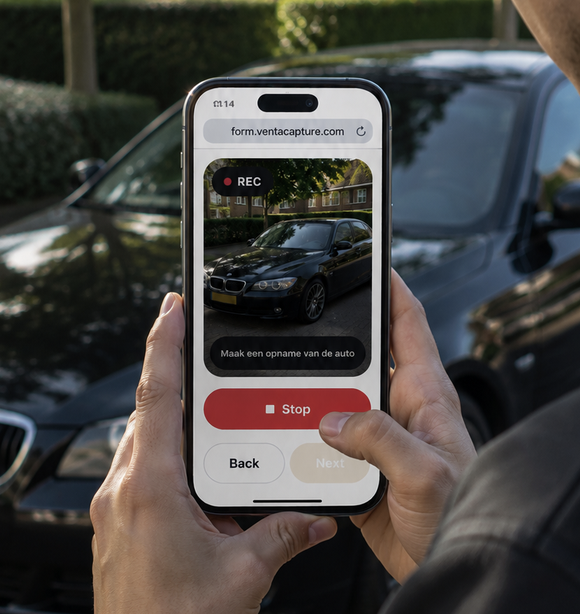
Venta Capture turns the driver's smartphone into a guided capture tool. Instead of "please send us some photos of the car", which produces two blurry shots of a bumper, the driver follows a defined sequence your team controls. Your fair wear and tear knowledge goes into the flow once; every driver then walks the same route around the car. This is the same guided capture platform used for trade-in appraisals and dealership condition workflows, pointed at end of lease.
Here's the shape of a lease return flow:
- The link goes out on a fixed trigger. Sixty to ninety days before term, by SMS, email, WhatsApp, or a QR code in the return letter. No app to install, no account to create; the flow opens in the phone's browser, in any of 15 languages.
- The flow walks the driver shot by shot. Full front. Each side. Rear. Every wheel up close. Windshield. Interior, trunk, odometer. A short video circuit of the car while they describe anything they know about. Conditional questions close out the equipment list: both keys? charging cable? parcel shelf?
- Recording is live only. The flow captures through the camera in real time and doesn't accept gallery uploads, so the record shows the car as it stood during the capture session, not a photo from eight months ago.
- The submission arrives as one structured case. Video, photos, answers, and a searchable transcript of what the driver said, together in a shared inbox with an owner and a status instead of scattered across email attachments.
- Gaps get fixed with a retake, not a re-do. Driver skipped the rear wheel? Your reviewer requests exactly that shot. The addition lands in the same case, and the audit history records it.
From the review screen, three outcomes replace the old scramble. Damage that's clearly chargeable gets estimated and communicated before the car comes back, while the driver can still fix it themselves. Clean cars skip straight to logistics and remarketing. And the contentious cases, the ones that need an expert's eyes in person, get the physical inspection slot they deserve. The model is remote-first, not remote-only.
If you'd rather see it run than read about it, book a 15-minute demo and bring your current condition report along for comparison.

What makes the condition record hold up later
Collecting better footage is half the job. The other half is being able to stand behind it eight months later, when the dispute arrives. This is where a structured capture beats a folder of JPEGs, because each submission carries its own integrity layer:
- A server-set time of receipt. The moment your system received the submission, recorded on your side rather than trusted from the phone's clock.
- A SHA-256 fingerprint for every file. If anyone asks "is this still the exact file you received?", the fingerprint answers it, and it can be verified outside the platform.
- A signed seal on the submission. Independently checkable with a public key, so verification doesn't rest on someone squinting at a screen.
- A recorded session and signal set. Venta Capture logs 28 control points per submission: 10 automatic signals, 21 recorded session events, one signed seal, including location context to ±11 meters and flags like a virtual camera or a jailbroken device.
- An audit history after arrival. Who reviewed the case, what was requested, what changed. The dispute file writes itself as the case moves.
Now the honest part, because overclaiming is how evidence gets thrown out. The server timestamp proves when your system received the capture. It does not prove when the curb met the wheel. A sealed file proves the footage wasn't altered after arrival, not that the scene in front of the camera told the whole story. And the technical signals are exactly that: signals, not verdicts. A flagged device is a reason for a human to look closer, never an automatic ruling.
Stating those limits plainly strengthens your position rather than weakening it, because a lessor who says "here is what we received, when we received it, and proof it hasn't changed since" is making a claim that survives scrutiny. The assessor still applies your fair wear and tear standard. The platform just makes sure the material they're applying it to is complete, consistent, and verifiable.
Rolling it out across locations
The teams that get value from this quickly tend to follow the same six steps:
- Map the current defleet path first. Where do returns physically land, who reviews condition today, and where do the disputed invoices come from? Fix the flow around the real process, not the org chart.
- Build one flow, encode your standard. Put your fair wear and tear thresholds into the capture steps and questions. The point is that Amsterdam, Antwerp, and Atlanta stop producing three different condition reports for the same car.
- Send on a trigger, not a whim. Sixty to ninety days before term is the sweet spot: early enough for the driver to fix chargeable damage or flag a mileage problem, late enough to reflect the car that actually returns. Worth knowing: FN50 data shows 20% of lease cars come back over their contracted mileage, at an average recharge of £587. An early capture turns that into a conversation instead of a surprise.
- Review as one queue. Route submissions by status: clean, chargeable, needs a closer look. Your assessors spend their time judging condition, not chasing photos.
- Reserve in-person slots for the cars that need them. Dealer-group service departments handling returns get their inspection capacity back for the contentious minority.
- Keep before and after records on repairs. When you recondition before remarketing, capture the after state too. The same case then covers the charge and the resale story.
For long contracts, some teams also send a condition capture at mid-term: same flow, same car, a year apart, which gives you condition visibility over time instead of one anxious snapshot at the end. And if your group already sends aftersales video updates to customers, this is the reverse lane: VentaVid sends video to the customer, Venta Capture collects it from them.
Tools that let the driver do the return inspection on their own phone are compared in vehicle self-inspection tools compared.
Frequently asked questions
What is a lease return inspection?
It's the condition check performed when a leased vehicle comes back at end of term, measured against the contract's fair wear and tear standard. The resulting report determines end-of-contract charges for damage, missing equipment, and excess mileage.
How long before lease end should the condition capture go out?
Sixty to ninety days before term works best, in line with the pre-inspection window most finance companies already recommend. That leaves the driver time to repair chargeable damage or return the car informed, and leaves you time to plan remarketing.
Can drivers really document the car themselves?
Yes, because the flow does the knowing for them. The driver doesn't decide which angles matter; your capture sequence does, shot by shot, with retakes for anything missed. No app or account is needed, which is what keeps completion friction low.
What happens if the driver disputes a charge anyway?
Disputes don't become impossible; they become arguable on better material. You bring a sealed, timestamped case with an audit history instead of a loose photo folder, and in the UK an unresolved case can still go to the BVRLA, whose engineer's decision is binding on members.
Does Venta Capture decide what counts as chargeable damage?
No. It collects and seals the evidence; your assessor applies your fair wear and tear standard and makes the call. Technical signals are a reason to look closer, not an automated verdict.
How is this different from a live video inspection?
A live inspection still needs your expert and the driver available at the same moment, which caps daily throughput at your calendar. Asynchronous capture removes the appointment: the driver records when it suits them, your team reviews when it suits you, and live or physical inspection is kept for cases that warrant it.
Talk to us
Lease maturities are climbing into 2027, charge rates are at record highs, and half of every challenged invoice is currently being given back. Inspecting harder won't fix that. Documenting better, earlier, and the same way at every location will.
What it takes to start.
- Free account, no credit card. Build a lease return flow and send the link to your own phone before you show anyone else.
- Nothing for drivers to install. The capture runs in the phone's browser, guided step by step.
- Prefer a walkthrough first? Book a demo and we'll build a return flow around your fair wear and tear standard, live.
Venta Capture is built by the VentaVid team for the people who run returns, claims, and inspections.
Start a free account and have your first lease return flow ready before the next batch of maturities lands.