
What is a trade-in appraisal: trade-in appraisal explained for used car managers
A trade-in appraisal is the value a dealership assigns to a customer's vehicle when that vehicle is being offered as part payment against another car, produced by combining a condition assessment of the specific unit with current market data on what it will retail or wholesale for. It ends in one number.
For dealerships
See the car before it arrives
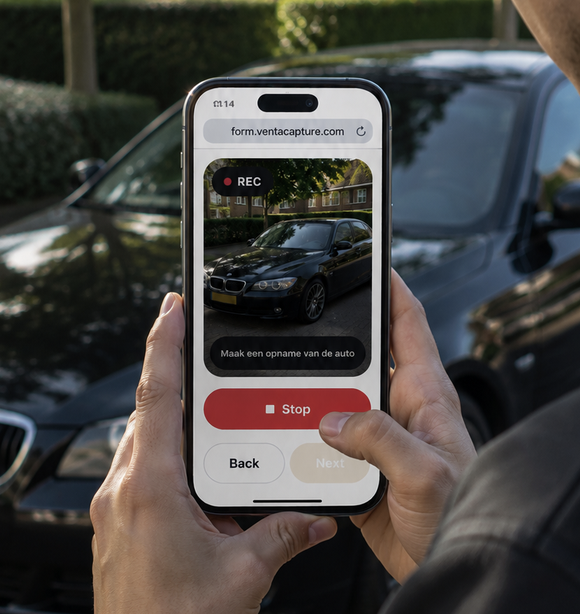
Venta Capture, a product of VentaVid, sends the customer a guided capture link, so appraisals, intake and returns start with the vehicle you can actually see.
You will hear it called a trade appraisal, a trade valuation, or just the trade number. In the UK and Ireland the same job is a part exchange appraisal, usually shortened to PX.
What does a trade-in appraisal actually decide?
Three things at once, which is why it carries more weight than people outside the used car department tend to assume:
- What the customer is allowed. The figure that lands on the deal sheet and then gets negotiated.
- Whether the car is retailed or wholesaled. Frontline retail, auction, and straight to a wholesaler are three very different money outcomes.
- What the reconditioning budget is. The appraiser's damage list becomes the shop's work list. Anything not on it still gets fixed, it just gets fixed out of gross.
Cox Automotive's used vehicle KPI benchmarks put the appraisal-to-trade ratio at 50% or better, meaning at least half the vehicles you appraise should end up as trades. A ratio sitting well under that usually says the appraisals are landing too low, or arriving too slowly, to close.

How is a trade-in appraisal calculated?
The arithmetic is simple. The inputs are where it gets difficult.
- Start from market value: recent auction results, live retail comparables, and the book for the exact trim, mileage and specification.
- Subtract reconditioning: the estimated cost of making the car frontline ready, taken from the condition assessment.
- Subtract the pack and the holding cost: whatever your store charges per unit, plus the days the car will sit before it sells.
- Apply the wholesale floor: if the car is wrong for your lot, the number becomes what a wholesale buyer will pay, not what a retail buyer would.
- Set the allowance: the desk decides what gets shown to the customer, which is a negotiating position rather than the appraisal itself.
Keep those last two apart in your own head. The appraised value is what the car is worth to the store. The allowance is what appears on the paperwork, and the gap between them can be moved around inside the deal.
Trade-in appraisal and vehicle appraisal: the same act, one specific case
Vehicle appraisal is the general act of putting a value on a vehicle for any reason at all: a lease return, an insurance settlement, a fleet disposal, a finance valuation, a straight cash buy from the public. A trade-in appraisal is that same act in one specific situation, where the car is being offered against the purchase of another one.
The distinction is worth holding onto because the trade case carries an extra variable that a plain valuation does not. The number is also a lever in a live negotiation, and that pressure is exactly what nudges an appraiser into being generous about condition.
Trade-in appraisal explained: a practical example
A three-year-old estate comes in against a newer unit. Market data supports 14,200 retail-ready, the appraiser writes 900 of reconditioning for tyres, a bumper scuff and a service, and the store allows 12,600.
The car goes through the shop. The front tyres are a mismatched pair, the scuff carries a cracked mounting tab behind it, and the rear brakes are at the wear limit. Actual recon lands at 1,750. The market never moved. The appraisal did, by 850, after the car was already bought.
Where the money is actually lost
Rarely in the market data. Almost always in the condition assessment, and almost always in the same handful of places:
- The appraisal happened in the rain, at dusk, or in a dark corner of the lot, so panel damage was never visible in the first place.
- Nobody drove it, so the noise, the pull and the warning light all arrived later.
- No underside, no tread depths, no interior detail, so the write-up is a memory rather than a record.
- It was appraised sight unseen from customer photos or a description over the phone.
- Time passed. Wholesale values moved 1.4% in a single month between June and July 2026 on the Manheim Used Vehicle Value Index, so an appraisal left sitting for a fortnight is already a different number.
Whatever the appraiser missed does not evaporate. It comes back as recon cost once the car is on your lot and the work order is open, which is the honest test of whether an appraisal was any good. What happens in between is covered in reconditioning and used car inspection.
For the sight-unseen case there is a tooling answer worth knowing about. Venta Capture, a product of VentaVid, sends the customer a link and guides them through the specific views an appraiser needs: VIN, odometer, each corner, tread, the underside, and any damage they want to declare. The submission arrives as a structured case rather than four photos in a text message. It values nothing on its own: guided capture collects the views, and the appraiser still sets the number. The route is described in more detail in online trade-in appraisal.
In practice: see how car dealerships use Venta Capture.