
What is part exchange: part exchange explained, and why Americans call it something else
Part exchange is the UK term for handing your existing car to a dealer as part of the payment for the next one. The dealer values the incoming car, deducts that figure from the price of the vehicle being bought, and the customer covers the balance in cash, finance, or a mix of the two.
For dealerships
See the car before it arrives
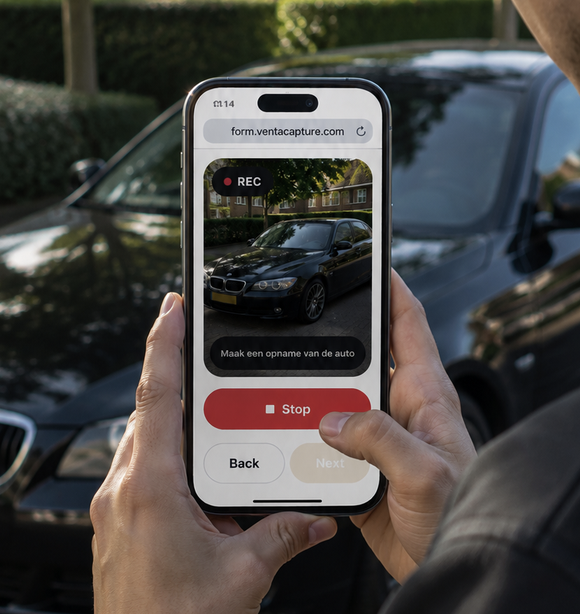
Venta Capture, a product of VentaVid, sends the customer a guided capture link, so appraisals, intake and returns start with the vehicle you can actually see.
Part exchange or trade-in: is there a difference?
No. Part exchange is what the transaction is called in the UK and Ireland. In the United States and Canada the same transaction is called a trade-in, and the two words describe identical mechanics: one vehicle in, one vehicle out, one net figure to settle.
You will see it shortened to part-ex or PX in stock notes, adverts and DMS fields, and written as both "part exchange" and "part-exchange" depending on house style. Australian and South African dealers use trade-in more often than part exchange, and multinational groups usually standardise on trade-in in their systems because the software came from the US. The appraisal itself is the same job either way, which is covered in trade-in appraisal.

How does a part exchange work, step by step?
- Appraisal. The dealer inspects the car, records mileage, condition, service history, keys, tyres and any damage, and checks provenance and outstanding finance.
- Valuation. A trade or wholesale figure is taken from a valuation guide, then adjusted down for the work the car needs and up for anything genuinely in its favour.
- Settlement check. If there is finance on the car, the dealer requests a settlement figure from the finance house, valid for a set number of days.
- The offer. The customer is shown one number: what the dealer will allow against the new car.
- Equity position. Allowance minus settlement gives either positive equity that reduces the deposit needed, or negative equity that has to be paid or rolled into the new agreement.
- Handover. The car changes hands, the finance is settled by the dealer, and the vehicle goes into stock, to auction, or straight to a trade buyer.
Part exchange example: the settlement nobody checked
A customer expects 9,000 pounds for her car and is quietly pleased when the dealer offers 9,200 pounds. Then the settlement figure comes back from the finance house at 10,400 pounds.
She is 1,200 pounds in negative equity, so the part exchange does not fund the deposit at all, it adds to what she has to borrow. Nothing about the valuation was wrong. The deal simply looked different once both halves of the arithmetic were on the table.
Where part exchange valuations go wrong
Almost every dispute traces back to a difference between the car the dealer priced and the car that turned up.
- Damage that was described rather than shown. "A couple of small scratches" covers everything from a trolley mark to a keyed door.
- Missing items. One key instead of two, no locking wheel nut, no service book, no charging cable on an EV. Each one is a real deduction.
- Tyres and brakes. Cheap to overlook on a walk round, expensive at preparation.
- Warning lights. A dashboard light that only appears when the engine is warm rarely features in the customer's account of the car.
- A figure that expired. Valuations and settlement quotes both go stale, and re-quoting on collection day is how goodwill gets spent.
Where the appraisal happens before the customer arrives, this is exactly the risk that structured remote capture is meant to shrink: see how an online trade-in appraisal is put together.
What part exchange is not
- It is not the retail price of your car. The allowance is a trade figure, because the dealer still has to prepare, warrant, advertise and hold the car before anyone buys it. The difference between the two sides is set out in retail valuation.
- It is not a separate sale. Legally and commercially it is one transaction with a net figure, which is why an inflated allowance can be funded by a smaller discount, and often is.
- It is not the same as a car buying service. Selling to an online buyer is a standalone sale of your car at a wholesale price, with no vehicle purchased in return. That price is derived the same way, as described under wholesale valuation.
- It is not a guaranteed price. Nearly every part exchange offer is conditional on the car being as described on inspection.
Why dealers want the part exchange
Stock is the constraint in used car retail, and a part exchange is stock you did not have to bid for at auction, with a known owner and a known history. It also anchors the customer to the deal: a car that has been valued, checked and settled is much harder to walk away from than a quote on a screen.
That is the quiet reason appraisal quality matters more than appraisal speed. A part exchange bought 400 pounds wrong does not show up on the sales report this month. It shows up as a car that is still sitting on the pitch in ninety days.
In practice: see how car dealerships use Venta Capture.