
What is retail valuation: retail valuation explained for used car retailers
Retail valuation is the price a used vehicle is expected to sell for on a dealer's forecourt once it has been prepared, warranted and advertised. It is the consumer facing side of a car's value, and it sits above the trade or wholesale figure the same vehicle would change hands for between businesses.
For dealerships
See the car before it arrives
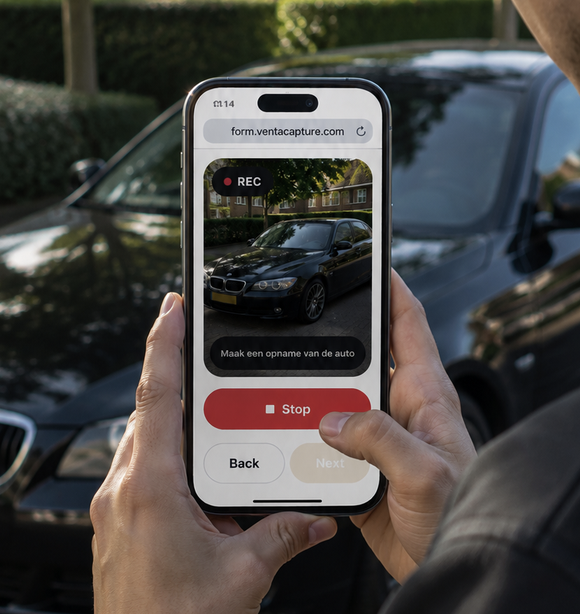
Venta Capture, a product of VentaVid, sends the customer a guided capture link, so appraisals, intake and returns start with the vehicle you can actually see.
What does retail valuation mean on the forecourt?
Every used car carries two prices at the same moment. One is what a dealer would pay to own it. The other is what a retail customer will pay to drive it away, tax paid, valeted, with a warranty on it. Retail valuation is the second number.
Valuation providers treat it as a separate product line rather than a mark up applied to trade. cap hpi builds its retail values from live advertising rather than auction results, analysing over 700,000 unique dealer adverts a day from the major portals. A retail figure is therefore a statement about the advertising market, not the trade market, and the two can move in different directions in the same week.
The volumes involved are not small. The SMMT recorded 7,807,872 used car transactions in the UK in 2025, up 2.2 percent on the year. Nearly all of them had a retail valuation sitting behind the windscreen price.

How is a retail valuation calculated?
- Base figure by derivative. Model, trim, engine, gearbox and registration date, priced against what comparable cars are being advertised at right now.
- Mileage adjustment. Applied against the expected mileage for the age of the car, up as well as down.
- Condition grade. Paint, panels, wheels, glass, interior, tyres. Anything that has to be put right before the car goes on display.
- Specification. Factory options that a buyer will search for, and options that quietly add nothing.
- Provenance. Service history, number of previous keepers, outstanding finance, recorded damage, plate changes.
- Local demand and days to sell. The same car has a different retail figure in two towns, and a different figure again in February than in August.
Retail valuation versus wholesale valuation: what fills the gap
The distance between the two numbers is not profit. Most of it has already been spent by the time the car reaches the display line.
- Reconditioning. Data compiled by the National Independent Automobile Dealers Association put the average recon cost at 1,160 US dollars per unit in 2022, rising past 1,300 dollars in the first quarter of 2023.
- Preparation. Safety inspection, service, tyres, brakes, valet, photography and the advert itself.
- Warranty and cover. The promise that turns a wholesale asset into a retail product.
- Holding cost. Funding, insurance and floor space for every day the car sits unsold.
- Margin. Whatever survives the four items above.
Working backwards from retail to the number you can afford to pay is the whole discipline of buying stock. That is why the two figures are quoted together, and why wholesale valuation is best read as retail minus everything that has to happen in between.
Retail valuation example: a three year old hatchback
A 2023 hatchback with 34,000 miles carries a retail valuation of 14,750 pounds. It needs two tyres, a front bumper respray and a service, which comes to roughly 900 pounds, and the dealer wants 1,200 pounds of gross plus a 300 pound warranty provision.
That leaves about 12,350 pounds as the most the car is worth to buy. If the customer is expecting 13,500 pounds for it, the conversation is not about goodwill. It is about which of those four deductions the dealer is willing to shrink.
What retail valuation is commonly confused with
- Asking price. The retail valuation is a guide to the market. The asking price is a decision, and dealers deliberately sit above or below the guide depending on how fast they want the car gone.
- Private sale value. A private seller has no preparation cost and offers no warranty, so a private advert usually sits between the trade figure and the retail figure.
- The part exchange offer. The number a customer is quoted for their own car is a trade figure adjusted for its condition, not a retail valuation. See part exchange for how the two get confused in the showroom.
- Insurance settlement value. An insurer's market value answers a different question, using its own basis of assessment.
When the retail figure moves
Retail values are republished frequently because the advertising market they are drawn from changes constantly. New car supply, finance rates, fuel prices, seasonality and a single OEM discount campaign all feed through to what a used equivalent can be advertised at.
For a sales manager, the practical consequence is that a retail valuation has a shelf life. A figure taken three weeks ago and used to justify today's part exchange offer is not evidence, it is a memory. Pulling a live figure at the point of appraisal is the difference, which is one reason a structured online trade-in appraisal tends to price better than a phone estimate.
In practice: see how car dealerships use Venta Capture.