


An online trade-in appraisal is a firm or provisional number a dealership gives on a customer's car before it arrives, priced from photos, video and answers the customer records on their own phone. It holds up when the dealership, not the customer, decides what gets filmed and in what order, when the appraiser is honest about what a phone cannot show, and when the offer says in writing what gets checked on arrival. Get those three right and the sight-unseen number survives the handover. Skip them and the deal gets re-priced on your driveway.
This post in 30 seconds.
- The problem: sight-unseen trade-in appraisals get built on photos the customer chose. The damage they cropped out becomes a renegotiation at handover.
- The data: 40% of appraisals that lean on default recon estimates are off by $1,000 or more, according to vAuto. Bad inputs make that worse.
- The fix: a fixed shot list in a fixed order, a clear line between what you priced and what you still check, and guided capture so the customer follows your appraiser's walk instead of their own instinct.
- Who this is for: used car managers and sales managers who pencil trades from emails and phone calls, and are tired of walking numbers back in person.
The number was $14,200 on the phone. It's $13,400 on the driveway.
You've run this scene. The customer sent six photos and said the car was clean. Your appraiser penciled it sight-unseen, the desk built the deal around it, and then the car showed up with a resprayed quarter panel, two curbed wheels and a windshield chip nobody mentioned. Now someone has to walk the number back while the customer stands there, already having spent the original figure in their head.
A note on who's writing this: I co-founded VentaVid, and we build Venta Capture, a product of VentaVid, for exactly this reader. Most of this post works with or without our tool. If you want to test it on a real trade this week, start for free.
Why do online trade-in appraisals get re-priced so often?
Ask a customer for photos of their trade and you'll get the car's good side. Most aren't hiding anything. They don't know what an appraiser needs, and when they do know, they have every reason to frame kindly.
The person with the least appraisal knowledge, and the most interest in a high number, is choosing the angles. A close-up of the scratch with no context. A three-quarter front shot that ends just before the rear bumper. Interior photos taken at night. Nothing on the tyres, nothing on the dash, no mileage.
Patrick Janes of vAuto put the failure mode bluntly in Wards Auto's piece on sight-unseen trade-ins:
"There's a problem if you discover at the customer's home that the trade-in is missing a front quarter panel the customer forgot to mention."
Patrick Janes, director of wholesale management solutions, vAuto (Wards Auto)
The industry has priced this in. Kelley Blue Book's own Instant Cash Offer FAQ says that if the information the customer provides differs from the dealer inspection, the offer amount may be decreased. That clause exists because everyone knows self-reported condition won't fully match the car.
The inputs problem stacks on an accuracy problem you already have inside the store. According to vAuto, citing Dale Pollak's research, 70% of dealers let appraisers apply default reconditioning costs to more than half the vehicles they appraise, and 40% of appraisals using those defaults are off by $1,000 or more. A recon guess on top of photos that hid the damage makes the driveway surprise predictable.
What it costs you:
- Renegotiated deals. The walk-back conversation kills trust right before signatures.
- Padded offers. Appraisers who've been burned bake a safety margin into every sight-unseen number, and lose the trades that were honestly described.
- Slow turnaround. Waiting to see the car before committing means the customer with three browser tabs open gets a firm number from someone else first.
Try it on your own phone
Want to see what a guided capture looks like?
Request a capture link and we email you one. Open it on your phone, follow the steps, and see exactly what your customer or field team would see. No app, no account.
How to inspect a trade-in remotely: the three options
There are three ways to get eyes on a trade before you commit to an actual cash value:
- Physical inspection. The customer brings the car in, or you send someone. Accurate, slow, and it defeats the point of an online appraisal.
- Live video call. An appraiser walks the customer around the car on a call. Better than loose photos, but two calendars have to line up for every trade.
- Asynchronous guided capture. You send a link. The customer records the exact views you specified, whenever suits them. Your appraiser reviews when it suits the desk. Nobody books a meeting.
The third option is what remote visual capture infrastructure does, and it's the one that scales past a handful of trades a week. Forty trade-in leads on a Saturday would mean forty video appointments under a live-call model. With guided capture they all record independently, and on Monday your appraiser works a queue instead of a calendar. If you're weighing tools for this, vehicle self-inspection tools compared lays out the options built for drivers and customers filming their own cars.
What should the customer film for a remote appraisal, and in what order?
I went through dealer forums on remote trade-ins before writing this, and the pattern in the DealerRefresh thread is hard to miss. One dealer says that probably 90% of the time, the sight-unseen price he gives is the same when the vehicle arrives. He controls the information request: specific details, specific pictures, and the damage conversation up front.
That is the whole trick. Your appraiser already walks the car in a fixed order on the lot. Give the customer the same walk. A sequence that works:
- Identification first. The VIN (door pillar sticker or windshield base) and the odometer with the engine running. You can't run the car without them, and they catch the wrong-trim surprise early.
- Dashboard with the engine on. Warning lights tell stories. Ask for a few seconds of video, not a photo, so you can hear the engine idle.
- Four corners, then four sides. Front, driver's side, rear, passenger side, then each three-quarter view. Shot from far enough back to show the whole panel, so lines and gaps are visible.
- Damage overview, then close-up. Every dent, scratch or chip: one shot from a few steps back to show where it sits, one close shot to show how bad it is.
- Wheels and tyres. All four, with the tread visible. Curbed rims show up here.
- Glass and lights. The windshield in daylight, from inside and out. Chips hide in reflections.
- Interior. Driver's seat bolster, front seats, rear seats, headliner, cargo area. Seat wear tells you more about real use than the odometer does.
- A walkaround video with commentary. One slow lap around the car while the customer says out loud what they know: repairs, accidents, warning lights, smells, anything that rattles.
- The disclosure questions. Accident history, outstanding finance, keys, service records, aftermarket parts. Asked as questions, answered before they submit.
Two capture conditions matter more than the camera. Daylight, out of direct sun, so glare doesn't hide paint damage. And a clean car, because dirt hides scratches and the customer knows it.
How to appraise a car from photos: what you can and cannot judge from a phone
Be honest with yourself and with the customer about where a phone stops. A clear video tells you a lot. It does not replace a test drive or a lift.
The left column is where the money usually moves at handover: cosmetic damage the customer didn't show. That is exactly what a fixed shot list fixes. The right column is what you price as an assumption and verify on arrival. Your appraisal process should keep the two apart, which brings us to the gap.
How do you handle the gap between the online figure and the physical check?
Every sight-unseen number has a gap: the part of the car nobody has seen yet. The stores that rarely re-price name it. The same DealerRefresh dealer says they're upfront about the possibility of the sight-unseen number being plus or minus when the vehicle arrives.
Make that concrete:
- Write down what the number assumes. "Based on the footage and answers received on Tuesday, assuming no frame damage, no warning lights while driving, and no odour." The customer reads it before they accept.
- Tie the offer to the capture, not to a conversation. If the car matches what they recorded, the number holds. If something appears that the footage could not show, you discuss that item, and only that item.
- Separate the cosmetic from the hidden. Anything visible in daylight on a clean car should already be in the number. You lose the right to re-price on a dent the customer filmed and your appraiser missed.
- Keep a validity window. Mileage and condition move. A short, stated window keeps the comparison fair to both sides.
The point is that the customer hears about the gap on day one, in writing, and not on the driveway.
How to avoid a re-price at handover
A re-price at handover is almost always one of two things: something the customer didn't show, or something the store didn't ask for. Both are fixable before the car moves.
- Don't give a number on an incomplete capture. Missing the rear bumper? Ask for that one view. A retake request for one angle costs the customer a minute. Skipping it costs you a renegotiation.
- Get the disclosure on camera. "Any accident repairs?" answered out loud in the walkaround video settles more arguments than a ticked box.
- Price the cosmetic fully. Recon on visible damage goes into the online figure, not into a handover deduction.
- Check the car against the same views on arrival. Same order, same angles. Your lot attendant compares like for like instead of starting a fresh appraisal.
- If you must adjust, show the evidence. Point at the customer's own footage next to the car. "This was here on Tuesday, this wasn't" is a short conversation.
The stakes keep rising. Per Edmunds data reported by Auto Remarketing, 29.6% of trade-ins toward new-vehicle purchases carried negative equity in Q2 2026, with an average of $6,884 owed. When nearly three in ten trade customers are underwater, there is no slack in the deal for an appraisal miss. A number that walks back $800 at handover unwinds the structure the desk built.

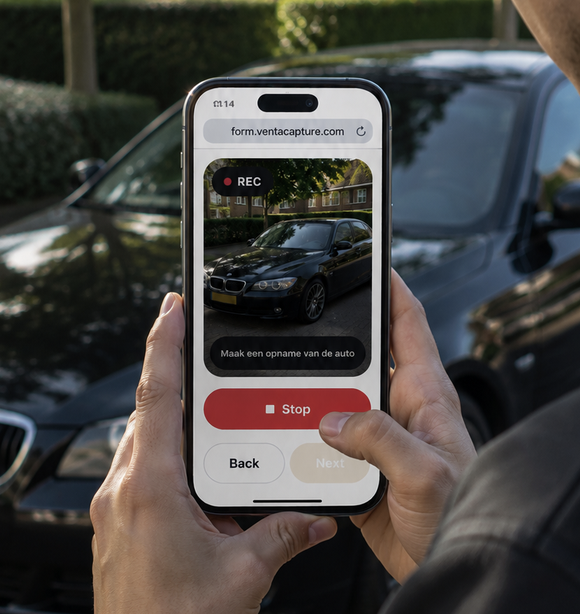
How Venta Capture runs a remote trade-in appraisal
This is the part that's ours. Venta Capture is guided visual capture: the customer records video and photos on their own phone, guided step by step, and the submission arrives as a structured, digitally sealed case. For a trade-in, it works in three moves.
1. Send a secure, personal capture link. From the first lead reply, by SMS, WhatsApp or email. There's no app to install and no account to create. The link opens the capture flow in the phone's browser, in the customer's language (it runs in 15 languages), in your own branding.
2. The customer follows your appraisal walk. Your team adjusts a ready-made workflow to your appraiser's checklist: the shot list above, a photo slot per view with an example image of what you want, a barcode scan for the VIN with typing as fallback, and the disclosure questions. The customer can talk while recording, and the spoken explanation is transcribed into the case, searchable later. If they say "there's a small scrape from a parking garage" on camera, that sentence is on the record. A customer who gets interrupted can continue later without starting over.
3. The case lands with your appraiser. Submissions arrive in a shared inbox on the Venta Capture platform for dealerships, where the used car manager reviews, comments and assigns. Missing the left rear wheel? Request a retake of exactly that view; the retake is linked to the original case, and the customer is asked why they're recording again.
Venta Capture doesn't value the car. It has no book and no algorithm handing you an ACV. Your appraiser sets the number, exactly as today, from a consistent set of views.
The part your desk will care about at handover is the sealed evidence:
- Recorded in the session, on this device. Photos and video recorded through the link carry a visible stamp with date, time and seal. If your workflow allows gallery uploads, those are checked and labelled separately, so you know which is which.
- Sealed on receipt. Every file gets a fingerprint and a signed seal, so the file you review on Thursday is verifiably the file that arrived on Monday. A timestamp from an independent timestamping authority records when the case existed, and a reviewer can print a proof of seal.
- Signals, not verdicts. More than 25 control points per submission record how the session went. Where you want more assurance, a session can also include a spoken code the customer reads out on video and a changing session code in the frame. They're observations for your appraiser, never an automatic accusation. A person decides.
One precision worth keeping: the timestamp proves when you received the footage, not when any damage happened. So when the car arrives worse than the capture showed, you're not relitigating memory against memory. You have a sealed baseline the customer recorded themselves, and the conversation gets short.
What changes when the car finally arrives
If the car matches the capture, the number holds and the deal closes on the figure everyone agreed to. If it doesn't, you're pointing at the customer's own walkaround from Tuesday, not arguing about what was said on a phone call. Fewer renegotiations either way, and the ones that remain are about something both parties can see.
Speed moves too. A guided capture takes the customer minutes, at 9 pm on their driveway if that's when they're free, and your appraiser reviews it the next morning between other work. Cox Automotive's 2025 digitization study found that dealers offering every purchase step online have doubled in two years. A firm, fast, sight-unseen number is increasingly part of the deal the customer expects.
If your last three trades all got re-priced at handover, the fastest fix is changing what arrives before the car does. Start for free and you can be live in 10 minutes with your first appraisal workflow.

Try Venta Capture on your own process
Build one flow for your highest-volume case type. Free, no credit card.
Rolling it out without adding friction
The fair objection first, because dealers on that same forum raised it: customers already know how to text photos, so why add a tool? Texting gives you the customer's choice of photos, which is the exact problem, and it leaves the attachments in one salesperson's phone instead of a case your whole desk can work.
For the customer, a capture link is less work than texting: tap, follow the prompts, done. For your team, rollout looks like this:
- Set up one workflow from your appraiser's checklist. The shot list above is a solid start. If you want accident history or payoff questions to change which steps follow, we set that up around your process.
- Put the link in the first trade reply. Website trade-in request submitted? The BDC answers with the capture link. Phone-up mentions a trade? Same link by text before the call ends. The dealership page shows where it slots in.
- Route captures to the appraiser. Cases land in the shared inbox and get assigned. "Copy for CRM" pastes the case into whatever system holds the deal. The number goes back to the customer the same day.
- Track two numbers. The share of sight-unseen offers that hold unchanged at arrival, and appraisal turnaround time. They're the honest scoreboard for whether this is working.
The appraisal is one part of the used car department. For the rest, from sourcing to pricing to the handover, see how to increase used car sales. Stores already using personalized video on the sales side often send the customer a short video back with the offer, which keeps the deal human while the appraisal stays structured. It fits the wider shift toward virtual selling at dealerships, and if you're auditing the rest of your stack, here's how dealers evaluate video software for dealerships.
Frequently asked questions
How does an online vehicle appraisal work?
The customer submits photos, video and answers about the car from their phone, the dealership's appraiser reviews them and gives a number, and the car is checked on arrival against what was submitted. The number holds best when the dealership sets the shot list and states what it still checks in person.
Can you appraise a car from photos?
You can price most of the cosmetic condition from good photos and video: body, paint, wheels, tyres, interior and warning lights. You cannot judge drive feel, frame damage, underbody rust or odour from a phone, so price those as stated assumptions and verify them at handover.
How accurate is an online trade-in appraisal?
As accurate as the person pricing it and the information they price from. With a fixed shot list in a fixed order, the sight-unseen number and the on-the-lot number converge; with whatever photos the customer chose, they drift apart.
What if the car arrives in worse condition than the photos showed?
Compare the car against the customer's own footage, view by view. Adjust only for what the footage could not show or the customer did not disclose, and show them the evidence when you do.
Do customers need to download an app for a remote appraisal?
Not with Venta Capture. The capture link opens in the phone's browser and there's no account to create. The customer taps the link, follows the steps and submits.
Can a customer fake the condition in a video?
Harder to manipulate doesn't mean impossible to deceive, and anyone claiming otherwise is overselling. Footage recorded in the session is stamped and sealed, uploads are labelled separately, and session signals give your appraiser reasons to look closer. Your appraiser weighs those observations and makes the call.
See the trade before it arrives
Every used car manager has a version of the $14,200-to-$13,400 story. A good online trade-in appraisal earns its keep by producing numbers that survive contact with the car, because you chose what you got to see and said up front what you'd still check.
Low-risk way to test it.
- Free account, no credit card. Set up your appraisal workflow and send a capture link the same day.
- Nothing for customers to install. A link in the browser, guided step by step, in 15 languages.
- Your appraiser stays in charge. Capture feeds the appraisal. Your people set the number.
Start for free and run your next sight-unseen trade through it. Stuck? Book a free setup call and we build your first workflow together. Prefer to see it on your own process first? Book a demo.