
Wholesale valuation explained: what a vehicle is worth in the trade
A wholesale valuation is the price a vehicle is expected to achieve in a business-to-business sale, typically through an auction or a trade marketplace, as opposed to the price a consumer would pay for it on a forecourt. Fleets, lessors and remarketing teams plan disposals against this number, because it is the one they will actually transact at.
For dealerships
See the car before it arrives
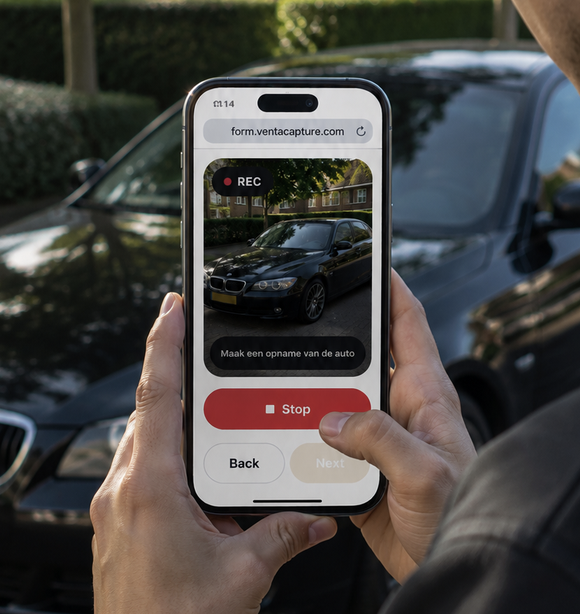
Venta Capture, a product of VentaVid, sends the customer a guided capture link, so appraisals, intake and returns start with the vehicle you can actually see.
It is also called the trade value, the auction value, or simply "trade", depending on which side of the industry the person asking sits on.
How is a wholesale valuation calculated?
It starts from a published guide value for the exact derivative, then gets adjusted downward or upward for everything specific to the individual vehicle.
- Derivative baseline: make, model, exact trim and engine, registration date, and body style. Two cars that look identical on a forecourt can sit hundreds apart on specification alone.
- Mileage adjustment: against the expected mileage for the vehicle's age, applied as a plus or minus rather than a flat rate.
- Condition grade: the output of the defleet appraisal, which is what converts the same guide value into different real numbers.
- Damage estimate: the cost to bring the vehicle up to a saleable standard, deducted whether or not the work will be done.
- Documentation: service history, keys, MOT remaining, V5 or equivalent, and any outstanding finance interest.
- Live demand: what that derivative has actually been fetching in the last few weeks, which can override the guide in either direction.

How wholesale valuation differs from retail valuation
The two answer different questions about the same vehicle. A wholesale valuation asks what another business will pay for it as stock. A retail valuation asks what an end customer will pay for it as a finished, warranted product.
The gap between them is not profit. It is the cost and risk of getting from one to the other: preparation, repair, transport, valeting, photography, warranty provision, the funding cost of holding the stock, and the possibility that it does not sell. That is the retail side's business, and the sizing of that gap belongs in the retail valuation entry rather than this one.
For a fleet, the discipline is simply to compare like with like. Quoting a retail figure in a disposal business case will always make the wholesale outcome look like underperformance.
Where the numbers come from
Guide providers publish trade values by condition rather than as a single figure. In the UK, cap hpi publishes trade values across three condition bands, Clean, Average and Below, so the same vehicle carries three different trade numbers depending on how it grades. That structure is why a condition appraisal is a pricing input and not just a damage list.
Market-level movement is tracked separately. Cox Automotive's Manheim Used Vehicle Value Index measures US wholesale used-vehicle prices using a model that controls for changes in the mix of vehicles sold, and it is published on the fifth business day of each month. The index reached 212.9 in June 2026, 2.1% above June 2025 on a mix, mileage and seasonally adjusted basis.
Wholesale valuation explained: a practical example
A three-year-old diesel estate defleets at 71,000 miles with a kerbed alloy, two scratched panels, and a full service history. The guide trade value at Clean is the headline figure, but the vehicle grades below that, so the mileage adjustment and an estimated preparation cost come off. The service history and a full set of keys pull a little back. The reserve is set from that adjusted number, not from the Clean guide figure the business case was originally written against.
What a wholesale valuation is not
- Not a residual value forecast: a residual value is a prediction made years in advance to price a lease. A wholesale valuation is what the vehicle is worth today.
- Not a trade-in offer: a dealer's part-exchange figure is a wholesale valuation with the dealer's own margin and risk already taken out of it.
- Not actual cash value: ACV is an insurance settlement concept applied to a loss, calculated for a different purpose under different rules.
- Not the achieved price: the valuation is an expectation. The hammer price is the fact, and on a thin day for that derivative the two can diverge sharply.
Why condition evidence changes the number
Because the grade is a pricing input, the quality of the appraisal has a direct cash effect. A vehicle described accurately, with photographs, sells to a wider pool of remote buyers who are willing to bid without seeing it. A thin or inconsistent description narrows the bidding to buyers who are physically present, and a narrower pool prices lower.
This is also where damage recorded at handover matters. Anything correctly identified as chargeable at the end of lease inspection is recovered from the lessee. Anything missed is absorbed by the wholesale price instead, which means a weak inspection process quietly shows up in disposal performance rather than in the recharge line.
Read this alongside remarketing, which is the process this valuation feeds, and online trade-in appraisal for how the same condition question is handled at the buying end of the market.
In practice: see how car dealerships use Venta Capture.