What is metadata verification: checking the capture time, location, device and software data attached to a submitted photo or video against records the submitter does not control, before a reviewer relies on the file.
Metadata verification is the checking of the data attached to a submitted photo or video, chiefly capture time, location, device and editing software, against records the submitter does not control, to judge how far the file can be relied on. It is the first thing a careful claims handler or inspector looks at, and the first thing a careful one refuses to take at face value.
It matters because metadata is both useful and fragile. The EXIF data a phone writes into a photo records when, where and on what it was taken, and any free tool can rewrite those fields in seconds. Messaging apps strip them entirely. The term is the same in UK and US usage; "EXIF verification" is the narrower phrase for the photo-file part of it.
What metadata verification checks
- Capture time: the time written by the device against the time the file was received, and against the file's own last-modified time.
- Location: the coordinates in the file, and whether the device position was read during the session or only claimed by the file.
- Device: the make and model in the file, and whether the same device has appeared on other submissions.
- Software: an editing application named in the file, or a capture time and a save time that disagree.
- Absence: no metadata at all, which has innocent causes as well as suspicious ones.
Why file metadata alone is not verification
A timestamp inside a file is a claim made by the phone that took it, on a clock its owner can change. Coordinates inside a file are a claim made by the same phone. Verification means comparing those claims with something independent: the time a server received the submission, a location read in the session rather than copied from the file, a device fingerprint observed rather than declared. Without an independent reference there is nothing to verify against, only fields to read.
How metadata verification works in a guided capture
Venta Capture, a product of VentaVid, draws the line in the case file. For every item the receipt time is verified by the server, and that is the only time the product calls verified. The file's own capture time, device, location and camera settings are shown and labelled unverified. Location is recorded during the session where the participant allows it; a refusal is stated plainly and treated as neutral. A photo recorded in the session is marked as taken via the platform. A photo uploaded from the gallery is marked "Provenance: Not verified" and checked on its metadata, on signs of editing, and on whether it already exists on the internet, with a green, amber or red panel and a plain-language caveat per finding: from the gallery, moment and place cannot be proven; no device data, which also happens after sharing through an app; re-saved by a messaging app, which is not an edit.
Metadata verification example: a tenant's water damage photo
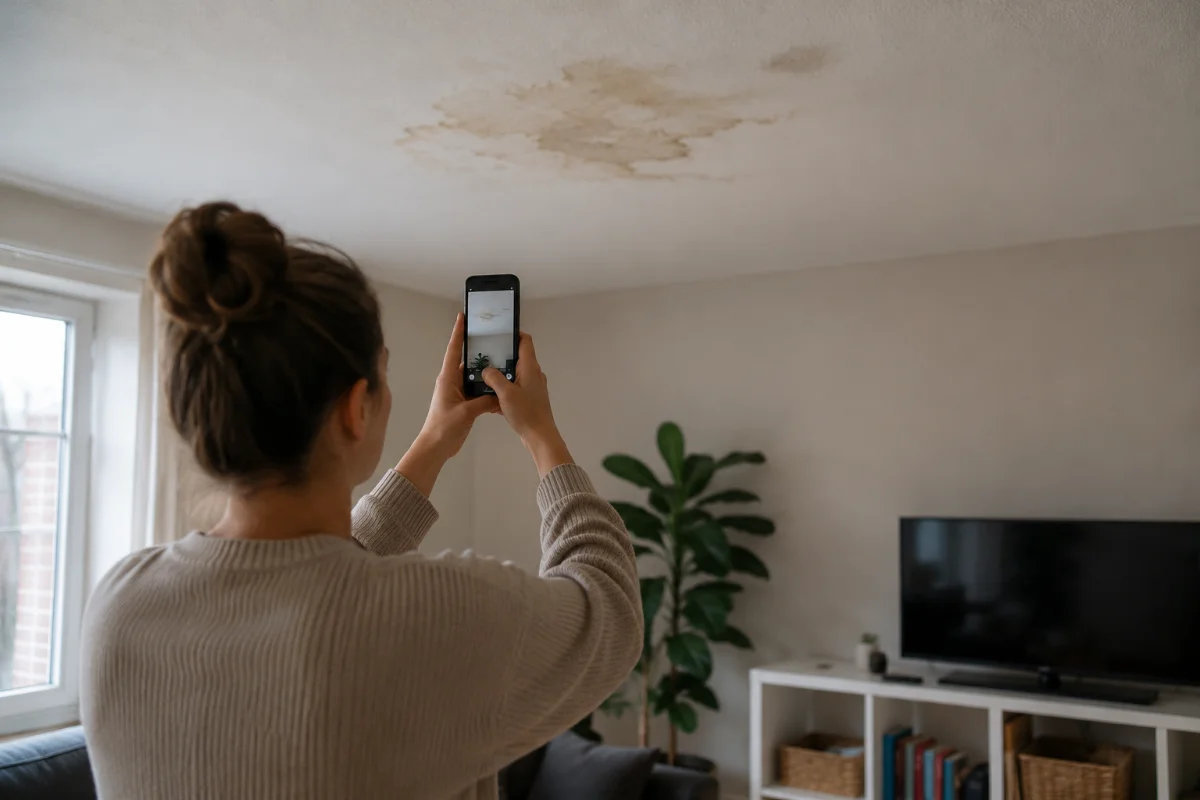
A tenant reports a ceiling stain under the bathroom of the flat above. He records three photos in the session, then uploads a fourth from his gallery, "taken the day it started". The three session photos carry a verified receipt time and a location within the building. The fourth shows no device data and no capture time.
The property manager reads the caveat: the metadata is missing, which is what happens when a photo has been sent through a messaging app. She does not treat it as suspicious, but she does not treat it as dated either. The session photos establish the current state; the upload becomes context for the tenant's account. She books the plumber on the session evidence and notes the distinction in the file, which is what a deposit adjudicator would want to see.
What metadata verification does not do
It does not prove when the event happened. A verified receipt time proves when the system received the file. The leak may have started days earlier.
It does not prove the content. Clean metadata on a photo of the wrong ceiling is still the wrong ceiling.
Missing data is not a verdict. Absent metadata is a reason to prefer a fresh session recording, not an accusation. Shared devices, shared networks and customers with several legitimate claims all produce reuse signals too.
The mistakes teams make: reading the phone's own timestamp as proof, rejecting a submission because one upload lacks data, treating coordinates copied from a file as a location check, and never asking for a retake when a fresh session recording would settle the question in two minutes.
Where the verification record goes
The verified receipt time, the session location, the per-item panel and the reviewer's comment stay in the case file with the media, sealed with a digital fingerprint and a session timeline, under the organisation's own reference. Anyone reopening the case later sees the same labels the original reviewer saw: what was verified, what was declared by the file, and what was missing. Details at the Venta Capture page.