
What is a vehicle condition report (VCR)? Condition reports explained
A vehicle condition report, usually shortened to VCR, is a structured record of a vehicle's physical and mechanical state at one point in time, written panel by panel with photographs, declared damage and often a numeric grade. It exists so that somebody who is not standing next to the car can price it, buy it, or accept it back with a defensible view of what they are getting.
For dealerships
See the car before it arrives
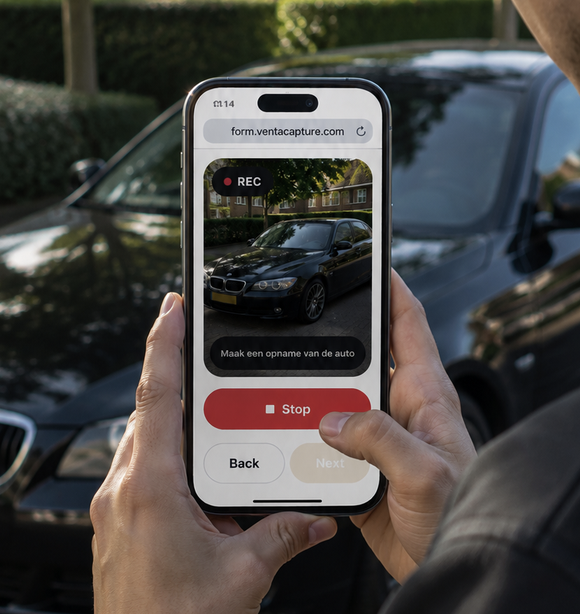
Venta Capture, a product of VentaVid, sends the customer a guided capture link, so appraisals, intake and returns start with the vehicle you can actually see.
Everything else about the vehicle can be looked up. Condition cannot. Somebody has to go and look, and the report is the record of them looking.
What goes into a vehicle condition report?
- Identity: VIN, registration, make, model, trim, and the date and location of the inspection.
- Mileage: the odometer figure, ideally photographed rather than typed.
- Exterior, panel by panel: dents, scratches, paint condition, panel gaps, glass, lights, and evidence of previous repair.
- Wheels and tyres: tread depth per corner, kerbing, brand mismatches, and the spare.
- Interior: upholstery tears, burns, staining, smells, trim damage, and whether the electronics work.
- Mechanical and structural: engine and gearbox behaviour, warning lights, fluid leaks, frame or structural damage, and any drive impression taken.
- Declarations and equipment: keys, service book, locking wheel nut, charging cables, plus announcements such as previous structural repair.
- Photographs: a fixed set of angles plus a close-up of every recorded defect.

How is a condition grade calculated?
Most reports condense the detail into a grade so buyers can filter and compare. In North American wholesale, the National Auto Auction Association adopted the industry's first uniform vehicle condition grading scale in 2006, and NAAA's arbitration guidelines make the seller responsible for the condition report written by or on behalf of the seller. That responsibility clause is the reason a grade has commercial teeth: it is what an arbitration case gets argued against.
The mechanics are consistent across schemes. Individual defects are costed or scored, the total is weighted against the vehicle's value and age, and the result maps to a grade band. Two vehicles can carry the same grade with very different problems, which is why the grade is a filter and the photographs are the evidence.
In UK and European leasing, the equivalent reference point is the BVRLA fair wear and tear standard, which defines what counts as normal deterioration from use rather than damage from an incident. Same purpose: make two different inspectors reach the same conclusion about the same car.
How a condition report differs from a history report
They get confused constantly, and they answer opposite questions. A vehicle history report is the recorded past, assembled from databases: titles, brands, reported incidents, ownership. A condition report is the observed present, assembled by a person with a camera. One can be clean while the other is alarming, in either direction. A car with a spotless history can be mechanically finished, and a car with a recorded accident can have been repaired properly and be in excellent shape.
Vehicle condition report example: a unit bought sight unseen
A dealer buys a three-year-old estate from an online wholesale listing on the strength of a grade and 40 photographs. The report declares two kerbed alloys, a 30 mm dent in the tailgate and 3 mm on the nearside front tyre. It arrives with all three, plus a cracked rear light lens nobody photographed. That last item is not a grading dispute. It is a coverage gap, and coverage gaps are what condition reports fail on far more often than grading judgement.
Where condition reports break down
- Inconsistent angles: if two inspectors shoot different views, their reports cannot be compared and neither can the vehicles.
- Missing close-ups: damage noted in text with no photograph is an assertion, not evidence.
- No capture time: without a reliable date and time, a dispute becomes an argument about when the damage appeared, and that argument is unwinnable in both directions.
- Free-text damage descriptions: "small dent, nearside rear" prices differently for every reader. This is precisely what a damage matrix exists to fix.
- Inspection capacity: reports get thinner exactly when volume is highest, which is when the money is largest.
Getting a consistent report without sending an inspector
The practical constraint is that a good condition report needs a trained pair of eyes at the vehicle, and the vehicle is rarely where the trained eyes are. That is the gap guided capture addresses: the organisation decides the angles, the order and the questions, and whoever is already standing at the car follows them.
Venta Capture, a product of VentaVid, works that way for condition reporting. A link goes to the customer, driver or member of staff at the vehicle, they are guided step by step through the identifiers, the mileage, the required angles and the conditional damage questions, and the submission arrives as a structured case with timestamps and integrity information attached. The same flow sits behind a lease return inspection and behind a wholesale condition write-up. The grading and the appraisal decision stay with the qualified assessor.
In practice: see how car dealerships use Venta Capture.
When the vehicle is not at the dealership, the condition report is increasingly filmed by the customer and reviewed at a distance. See remote inspection software: which type do you need?.