
Online car buying explained: what is online car buying, and how much of it is real?
Online car buying is the practice of completing part or all of a vehicle purchase over the internet: selecting the car, agreeing a price, arranging finance, valuing a part exchange and signing, without the buyer having to be in the showroom for every step. In practice it describes a spectrum rather than a single method.
For dealerships
See the car before it arrives
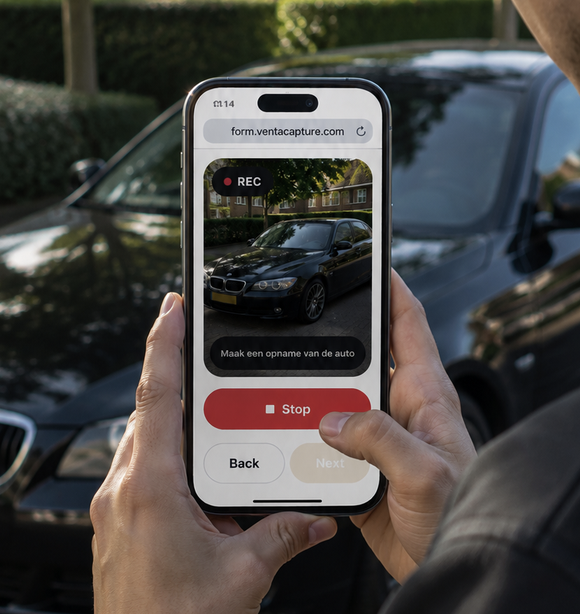
Venta Capture, a product of VentaVid, sends the customer a guided capture link, so appraisals, intake and returns start with the vehicle you can actually see.
What does online car buying actually cover?
At one end sits full ecommerce, where a customer selects, funds, signs and takes delivery without speaking to anyone. At the other end sits a lead form. Most of the market lives between the two, with some steps done at a kitchen table and the rest completed at a desk in the dealership.
The research period is where the online part has been settled for years. Auto Trader's analysis, published in December 2024, put the average car buying journey at 87 days, most of it spent browsing. What is still being negotiated is which transactional steps move online, not whether shopping does.

How much of car buying is really done online?
Cox Automotive's 2025 Car Buyer Journey study, based on 2,300 US buyers surveyed in autumn 2025, is unusually blunt about this. Just 7 percent bought entirely online, while 53 percent completed every step at the dealership. Meanwhile 63 percent said the ideal experience combines online and in person activity, and 28 percent said they wanted to buy fully online.
So the gap is not between dealers and buyers who want different things. It is between what buyers say they want and what they end up doing, and it is widest on the steps that involve numbers.
How does online car buying work end to end?
- Discovery. Portal or dealer site search, filtered by budget, monthly payment, or body style.
- Vehicle detail. Photos, video, specification, history, and increasingly a condition record for used stock.
- Deal structure. Price, finance quote, term, deposit, and any add on products.
- Part exchange. The customer's own car valued remotely, which is the step most likely to be revised later. See part exchange.
- Commitment. A reservation fee or deposit that takes the car off the market.
- Compliance and signing. Identity, affordability, finance documentation.
- Handover. Collection or delivery, and the first moment the buyer touches the car.
Online car buying example: the part exchange that moves the deal
A buyer configures a deal online at 289 pounds a month, based on a part exchange allowance of 8,500 pounds generated from registration, mileage and four self reported condition answers. Everything is agreed and a deposit is paid.
On collection day the car has kerbed alloys, one key and a service book that stops two years ago, so the allowance drops to 7,600 pounds and the monthly payment rises. The online deal was not dishonest. It was built on four answers when it needed twenty photographs.
Where the description does the work
Once the customer is not standing in front of the car, and you are not standing in front of theirs, everything rests on what has been recorded. The photographs, the video and the written condition record are no longer marketing, they are the terms of the deal, and every gap in them becomes a renegotiation on handover day.
That cuts both ways. It also means both sides gain return rights they would not have in the showroom: many markets, including the UK under the Consumer Contracts Regulations 2013 and the EU under Directive 2011/83/EU, give consumers a cancellation window on distance sales, and the detail differs by country. A car that comes back is a car that has to be re advertised, so accuracy is cheaper than optimism.
This is where Venta Capture, a product of VentaVid, fits into an online buying process: a link sent to whoever is with the vehicle, a guided sequence that insists on the panels people skip, and a structured, time stamped record back in the team's inbox. It makes surprises rarer. It does not make a physical inspection unnecessary where the value or the condition of the car calls for one.
Where online car buying still stops
- The test drive. No amount of video answers how a car rides on a road the buyer knows.
- Condition of used stock. The single biggest source of post sale disputes, and the reason sight unseen sales carry a different risk profile from new car ordering.
- Complex finance. Negative equity, adverse credit and multi vehicle deals still end up on a phone call.
- Trust. For a purchase this size, a lot of buyers want to meet the person selling it, and that preference has proved durable.
The dealerships doing well here are not the ones trying to remove the showroom. They are the ones making sure the customer never has to repeat themselves when they arrive at it, which is the practical ambition behind digital retailing.
In practice: see how car dealerships use Venta Capture.