
What is a sight unseen sale: sight unseen sales explained for dealers
A sight unseen sale is a vehicle sale agreed without the buyer physically inspecting the car first. The deal is done from photographs, video, a written description and a condition report, and the vehicle is delivered or collected only after the money and the paperwork are settled.
For dealerships
See the car before it arrives
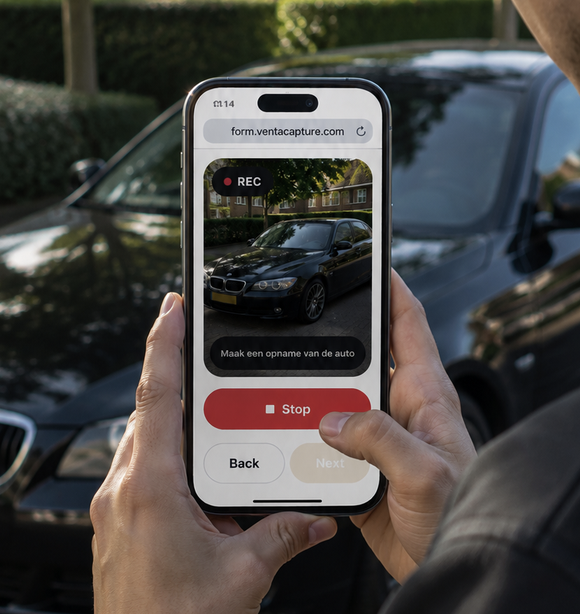
Venta Capture, a product of VentaVid, sends the customer a guided capture link, so appraisals, intake and returns start with the vehicle you can actually see.
What does sight unseen mean here?
The phrase is borrowed from auctions, where a lot bought sight unseen means bought on the catalogue description alone. In vehicle retail it is used more loosely: sometimes nobody from either side has looked at the car, sometimes the seller has inspected it thoroughly and the buyer has not.
The direction matters. A retail customer buying a used car for delivery has never seen it. A dealer taking a part exchange agreed over the phone has never seen that either, and is exposed in exactly the same way, just with the roles reversed.

How common are sight unseen sales?
Research from AA Cars, reported in March 2023, found 21 percent of UK drivers had bought a used car without seeing it first, double the 10 percent recorded in 2021. The same research found 73 percent said they would never buy a car unseen, and 57 percent said a warranty was the single thing most likely to change their mind.
Read those numbers together and you get the real picture. Sight unseen has moved from unusual to normal for a meaningful minority of buyers, while most of the market still wants to stand next to the car. Both facts are true at once, and a dealer's process has to serve both.
How does a sight unseen sale work?
- Description and imagery. A full photo set, a walkaround video, and damage recorded rather than glossed over.
- Condition report. Mileage, service history, MOT or inspection status, tyre depths, keys, known faults.
- Provenance. Finance check, write-off check, mileage verification.
- Terms. Deposit, balance, delivery date, and what happens if the car is not as described.
- Delivery or collection. Often with a short acceptance window in which the buyer inspects properly for the first time.
Sight unseen sale example: the scratch nobody photographed
A car is sold and delivered 200 miles away on the strength of eighteen photographs. The buyer walks round it on the driveway and finds a 15 centimetre scratch along the offside rear door, on the one panel the photo set skipped.
Nothing was hidden deliberately. But the buyer now has a defect that was not disclosed, a return right, and a collection cost that lands on the seller either way. One missing photograph outweighed the other seventeen.
Return rights raise the cost of a bad description
In the UK, a vehicle sale concluded at a distance falls under the Consumer Contracts (Information, Cancellation and Additional Charges) Regulations 2013, which give the consumer 14 days to cancel without giving a reason. Across the EU, Directive 2011/83/EU sets a comparable 14 day withdrawal period running from the day the consumer takes physical possession, and extends it by twelve months where the trader failed to tell the buyer the right existed.
These regimes are not universal, and they are not identical. Rules differ by country, by whether the buyer is a consumer or a business, and by exactly where and how the contract was concluded, so treat this as orientation and check the position in your own market. The commercial point survives the detail: in markets with distance selling protection, a poor description does not just cause an argument, it hands the buyer an exit and leaves you with a returned car, a transport bill and a unit that has aged in stock.
What sight unseen does not remove
A structured capture of the car, taken in a fixed order with prompts for the panels people skip, closes most of the gap that photographs alone leave open. That is the argument for guided capture: the seller decides what has to be shown, so the awkward corners get recorded whether or not anyone thinks to record them.
It reduces surprises. It does not replace a physical inspection where one is warranted. Underbody corrosion, a slipping clutch, a smell of damp, gearbox behaviour under load: these do not survive the journey through a phone camera, and a car that is high value, high mileage, or being bought for stock still deserves eyes and hands on it. Remote first, not remote only, is the honest position.
Collecting that structured record from whoever is standing next to the car is the job Venta Capture, a product of VentaVid, is built for: a link goes out, the person on site is guided through the shots, and a time stamped case comes back for the appraiser to review. The decision about the car stays with the appraiser.
If the car being bought unseen is the customer's own, the same logic applies in reverse, and the practicalities are worked through in online trade-in appraisal.
In practice: see how car dealerships use Venta Capture.