Venta Capture, a product of VentaVid, is a guided visual capture platform: your customer, tenant, driver or contractor films what you need on their own phone, guided step by step, with no app and no account, and it arrives as a sealed, structured case in your team's inbox. Along the way the session is observed: was the video streamed from the camera or handed over as a file, is virtual-camera software present, has this device been seen before. Each observation is a signal with its caveat, not a verdict.
More than 25 control points per submission: automatic signals, recorded session events and one signed seal.
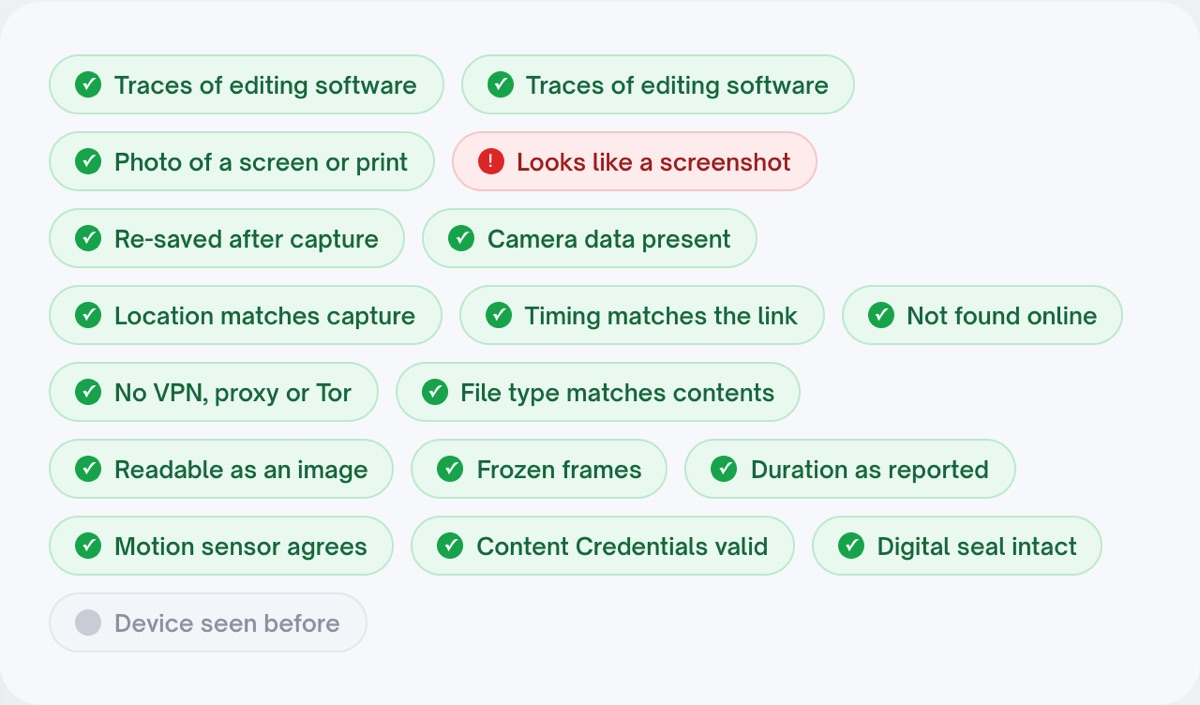
A video can be pointed at a screen. A "camera" can be software feeding an old file into the browser. A phone that filmed three unrelated claims this month is worth a second look. None of that is visible in a mailbox. Nobody can prove from the outside that a phone was tampered with, and a product that claims to is selling a verdict it cannot back.
A claims investigator suspects a recording was played from another screen, and has nothing but a feeling to put in the file.
A field service or warranty team receives a "recording" that turns out to be a file uploaded through a fallback, with no way to tell.
A rental desk or property manager sees the same device submit under three names, and never notices because nothing connects them.
Your team sends a secure personal capture link or shows a QR code. Recording only works on a phone: a desktop visitor gets a QR code to continue on their phone.
The customer records in the browser, step by step. Meanwhile the session is logged: camera stream confirmed or not, recording attempts, file fallback or not, device and network context.
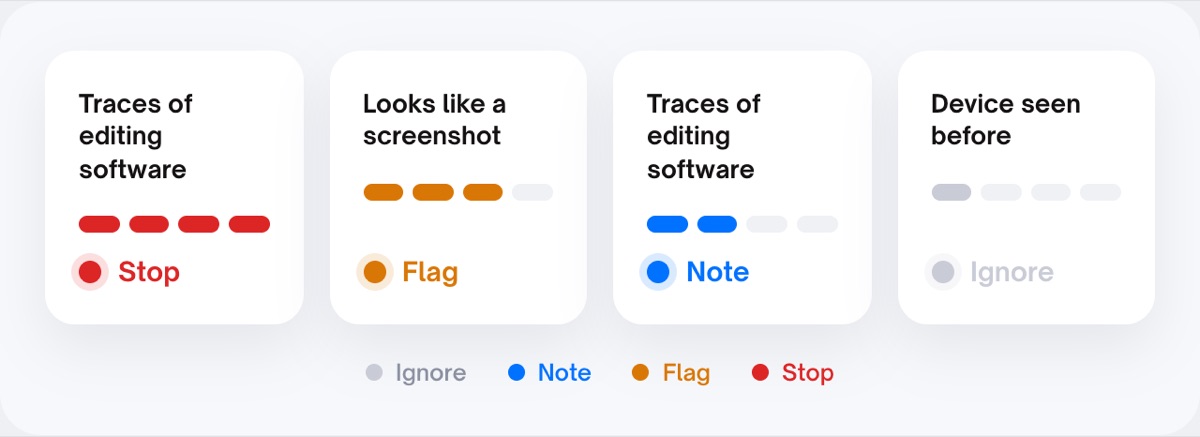
The submission is sealed with a server receipt time and fingerprint. Each device signal is assessed against your rule set: ignore, info, orange or red, some with a threshold.
The reviewer sees the signals and, next to each one, what it does and does not mean. They decide: handle, ask for a retake, or escalate with a reason.
Virtual-camera software, a file fallback, no streaming confirmation, a device seen before: these are observable and shown as such. That means your team works with what can be seen, not with a claim about a phone's internals that nobody can back.
Every signal carries its caveat: several attempts are normal, a shared family phone produces reuse, IP ranges are shared. That means a handler can put the finding in front of a customer or a court without overstating it.
You set where "normal" ends, per signal. That means an insurer with a strict appetite and a rental company with a relaxed one run the same product without either being told what to think.
Send a capture link to your own phone, record twice, and see how the case reports the second attempt.
Known virtual-camera software present; video arriving through a file fallback instead of a stream; no streaming confirmation; the session event ceiling reached; a sealing failure; a device or network seen before; a similar environment in an earlier submission.
Each signal is set independently to ignore, info (a note), orange (flag) or red (stop).
Recording attempts, for instance: trying again is normal, and you choose where normal ends, such as "flag from three".
Next to a virtual-camera finding: its presence does not prove it was used for this recording. Next to a device seen before: a shared household phone also produces reuse. Next to a network finding: IP ranges are shared and never a verdict on their own.
Time recorded and server verified, device context recorded, location declined by the submitter: shown as neutral, never counted anywhere, no hidden score.
How the product recognises a device without identifying a person: a non-identifying network fingerprint is kept for reuse signals while the raw IP address is deleted after a configurable number of days (default 14). See device fingerprinting and screen recapture in the glossary.
See also the internet image check, our claims discipline, what a case proves, and the claims investigation use case.

No, and nobody can with certainty from the outside. What the product does is observe the symptoms: virtual-camera software, a file instead of a stream, no streaming confirmation, a device seen before. Each is shown as a signal with its caveat.
A recording that reached the server as a file rather than as a stream confirmed by the browser during the session. It happens for innocent technical reasons too, which is why the signal says that a technical origin says nothing about the content.
Because you set it that way, or left the default. A family shares a phone, a fleet driver reports twice in a month. Reuse is worth knowing about, and you decide whether it is a note, a flag or nothing.
No. Opened on a computer, the page shows a QR code to continue on a phone. Recording is only possible in the mobile browser.
The raw IP address is deleted after a configurable number of days, default 14. A non-identifying network fingerprint remains so that reuse can be signalled. Location is optional and, when declined, recorded as neutral.
Send one link, read the session the way the product records it, and decide yourself.
Live in 10 minutes. Stuck? Book a free setup call and we build your first flow together.
