
What is remote troubleshooting: remote troubleshooting explained for support teams
Remote troubleshooting is the process of diagnosing and resolving a fault without attending the site, using what the person standing at the equipment can tell you, show you, or do on your instruction. A qualified specialist does the diagnosing. The person on site provides the access.
It is sometimes called remote diagnostics or remote support, and in field service organisations it usually sits immediately after remote triage: triage decides what happens next, troubleshooting is the attempt to make the answer "resolved from here".
How does remote troubleshooting work?
The loop is short and it repeats until the specialist either resolves the fault or knows enough to dispatch well.
- Gather: get the symptom, the error state, the equipment identifiers, and the context around it.
- Hypothesise: narrow to the plausible causes based on what is in front of you.
- Test: ask the person on site to do something specific and report what happened.
- Resolve or route: fix it, send a part, or dispatch with the correct parts, skills and expectations.
Only the first step is about gathering information in name. Every hypothesis after it is capped by what that step produced.

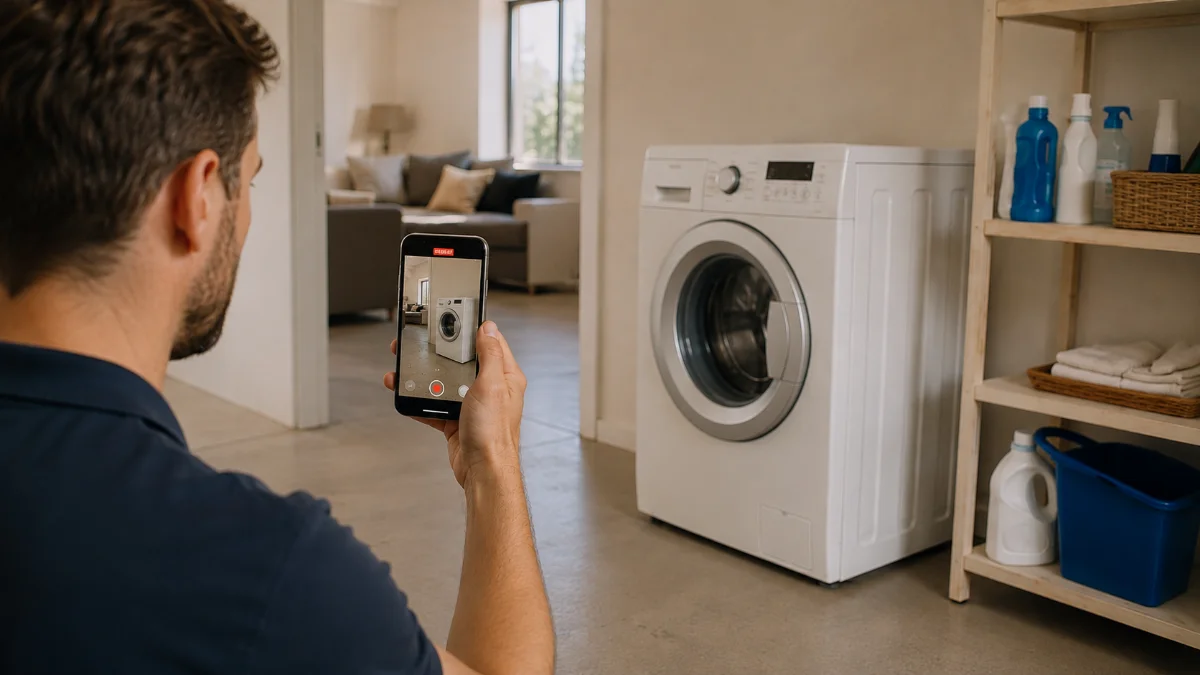
Why a description is the weakest input a troubleshooter can get
This is the part worth being blunt about. A described symptom is the lowest-quality input in the whole process, and it is the one most remote troubleshooting still runs on.
The problem is that a description has already passed through two lossy filters before it reaches the specialist. The person at the equipment notices the things a non-expert notices, which are rarely the diagnostic ones. Then they translate what they noticed into words they have, which are rarely the technical ones. "It's making a noise" and "there's an error on the screen" have survived both filters and carry almost nothing.
The inputs available, roughly in order of how much they constrain the diagnosis:
- A described symptom. Weakest. Consistent with a dozen faults.
- A code or reading, read aloud. Better, and transcription errors are common enough to be worth confirming.
- A photograph of the display, the part, or the installation. Now the specialist is reading the equipment rather than the description of it.
- Video of the fault occurring, with context. The sequence, the sound, the environment, what the operator actually did. Often decisive, because the timing of a fault is where the cause hides.
- Live telemetry. Strongest where it exists, and it does not exist on most installed equipment in the field.
Seeing the fault changes what is possible without a visit. Not because the specialist becomes cleverer, but because they stop diagnosing a description and start diagnosing the machine. The step from words to a picture is a larger jump in diagnostic power than any step further up that list.
Remote troubleshooting explained: a worked example
A customer reports a boiler "banging on startup". Over the phone that is consistent with at least five faults, and the safe call is to dispatch. With a 20 second video of the startup sequence, a photo of the pressure gauge, and a shot of the pipework at the pump, the same specialist narrows it to kettling on the heat exchanger. Either the customer is talked through a fix, or an engineer is booked with the flush kit already loaded. Both outcomes beat a diagnostic visit followed by a second visit with parts.
How is remote troubleshooting measured?
- Remote resolution rate: cases closed without anyone attending.
- Callback rate: of those closed remotely, how many returned within 30 days. A high remote resolution rate next to a rising callback rate is not a success, it is a deferral.
- First-time fix rate on dispatched jobs: whether the troubleshooting improved the visits it could not prevent.
- Time to first decision: how long the customer waited to learn what happens next.
- Avoided truck rolls, counted honestly, which means only cases that genuinely would have been dispatched.
Tooling moves these more than effort does. In HDI and MetricNet benchmarking analysis published by Jeff Rumburg, support desks using remote control technology ran first contact resolution roughly 10 percentage points higher than those without it. That is the IT equivalent of the same principle: give the specialist direct access to the thing rather than a report about it.
Where remote troubleshooting reaches its limit
It is remote-first, not remote-only. Plenty of faults need hands, tools, a safety isolation, or a part in a van. The goal is fewer uninformed visits, not zero visits.
The person on site may not be able to help. Height, confined space, live electrical work, or an operator not permitted to open a panel. Safety outranks resolution rate.
Connectivity and conditions. Plant rooms, basements and rural sites are exactly where signal fails.
The tool does not diagnose. Automatic image tagging and anomaly signals are a reason to look more closely. The specialist decides, and stays accountable for the decision.
A timestamp proves receipt, not occurrence. A system recording when a submission arrived tells you when it arrived, not when the fault happened. Useful, and routinely over-read.
On tooling for the visual part of this, Venta Capture, a product of VentaVid, sends the customer or operator a link and guides them step by step through exactly what the specialist needs to see, so the case arrives as a structured submission with video, photos, answers and a transcript instead of a sentence. Its customer support page reports 23 percent of customer problems solved without dispatching a technician and 4 out of 5 issues handled and closed the same day, which are the vendor's own reported outcomes rather than an industry benchmark. It does not diagnose anything. It gives the person who does something real to work from.
Deeper on the field service side in remote diagnostics for field service, and on how cases get sorted before they reach a specialist in support triage.
In practice: see how customer support teams use Venta Capture.