
Visual support explained: what the term covers, and where it splits
Visual support is the category of customer support and service methods in which the problem is shown rather than described, using the camera on a device the person already has. It is an umbrella term, not a single technique, and the two techniques underneath it work in different ways.
What does visual support mean?
Every support conversation runs on a description. The customer says the machine is making a noise, the display shows an error, the part looks bent. The agent then has to rebuild the situation from words, and the words come from someone who does not know which details matter.
Visual support closes that gap by moving the evidence from language to image. The agent stops interviewing and starts looking. Everything else about the term follows from that one change: the queue metrics, the privacy questions, the training, the reason it works at all.
Terminology varies by industry. Support teams say visual support or visual assistance. Field service teams say remote visual assistance or see what I see. Insurers say remote inspection. The spelling changes, the mechanism does not.

The two shapes visual support takes
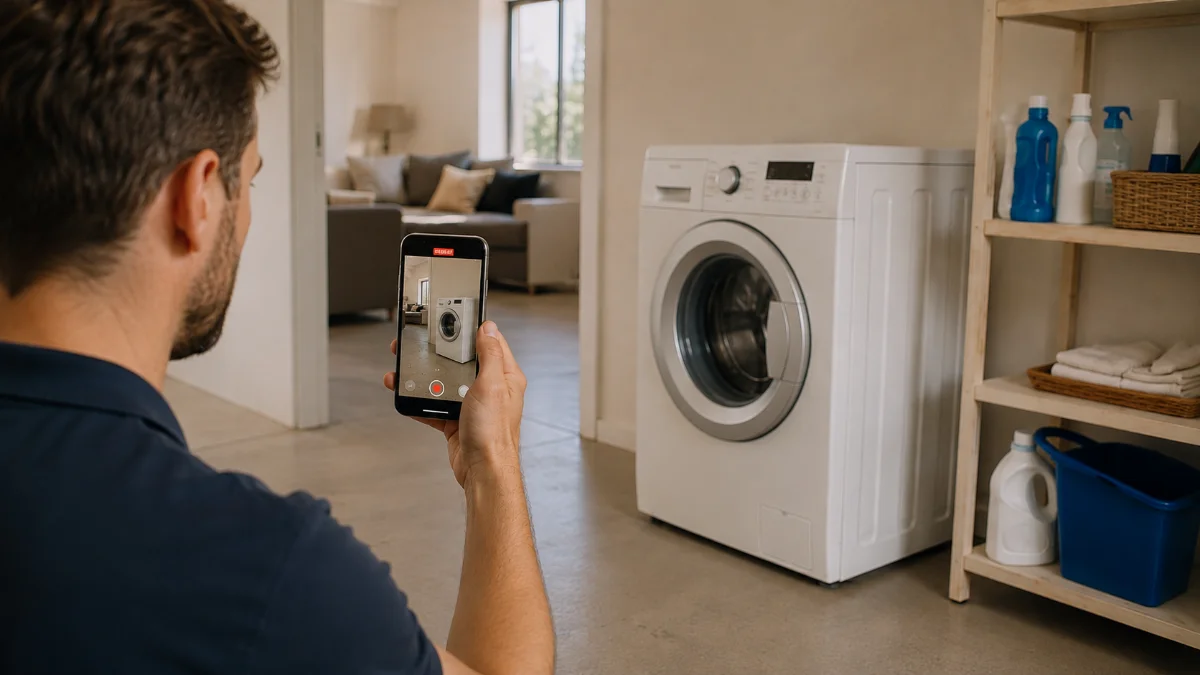
- Live video assistance. The customer and the agent are connected at the same moment. The agent sees the live camera feed, asks questions as they go, points at things on screen, and can chase whatever the first thirty seconds reveals. This is the older and better known half of the category, and it overlaps heavily with remote assistance.
- Asynchronous guided capture. The customer receives a link, works through a set of prompts on their own, and submits video and photos that a reviewer opens later. The organisation decides in advance what has to be shown and in what order, so the expertise sits in the flow rather than in the person on the call. See asynchronous capture for the model in full.
Screen based techniques sit alongside both. Co-browsing is visual support for a problem that lives inside a browser rather than in the physical world.
The trade off between live and asynchronous
Neither half is the better one. They fail in opposite directions, and that is the whole basis for choosing.
Live assistance needs two people free at the same moment. That is a real constraint at volume: capture capacity is capped by how many staff hours you can put behind cameras, and a customer who works shifts is genuinely hard to book. What you get for it is the follow up question. When the first look raises something nobody anticipated, a live agent can chase it immediately.
Asynchronous capture removes the scheduling problem entirely, and it removes the follow up question with it. The customer captures at eleven at night, the reviewer opens it at eight the next morning, and nobody waited. But if the flow forgot to ask for the serial number, nobody in the room notices, and the correction costs a second round trip. Latency is the other cost. A live session answers in twenty minutes. An asynchronous request answers whenever the customer gets to it.
Most support organisations that run both end up routing by urgency and by volume. Urgent and unusual goes live. High volume and predictable goes asynchronous.
Visual support explained: one dishwasher, two routes
A customer reports that a dishwasher is leaking. On the live route, an agent books a video call for the following afternoon, watches the customer tilt the phone under the machine, spots that the leak is coming from the inlet hose rather than the door seal, and orders the hose.
On the asynchronous route, the customer gets a link that evening and records four short clips: the machine, the underside, the connection at the wall, and the model plate. A technician reviews it the next morning and orders the same hose. The second route used no appointment and about four minutes of employee time. The first route would have caught an unexpected detail faster if the leak had turned out to be something stranger.
Where visual support earns its place
The economics are clearest wherever the alternative to looking is sending someone. The Technology and Services Industry Association puts the fully loaded cost of a field dispatch at around 1,000 US dollars once indirect costs are counted, which is why avoidable dispatch rate is a metric support directors actually watch.
The second gain is quieter and often larger: fewer wrong parts, fewer repeat visits, fewer cases that bounce between tiers because the second line could not picture what the first line was told. Seeing the fault also changes who gets sent, not only whether anyone gets sent.
What visual support is confused with
- Asking for photos. An open request for pictures is not visual support in any useful sense. The customer decides what matters, and they usually decide wrong. Guidance is the working part.
- Video calling. A video call is one delivery method inside the category, not the category.
- Automated diagnosis. Image analysis can tag and flag. The assessment stays with the qualified person, and a signal in a submission is a reason to look, never a verdict.
- Replacing visits. Visual support is a triage layer. The honest promise is to see first and act second, so the visits that still happen are better informed.
The asynchronous half of the category is the design of Venta Capture, a product of VentaVid: a link by SMS, WhatsApp or email, guided capture in the phone browser with no app and no account, and a structured case in a shared inbox for a reviewer to work from when they are ready.
In practice: see how customer support teams use Venta Capture.